Jerusalem artichoke, also known as sunchoke, is a perennial herbaceous tuberous plant belonging to the Asteraceae family. In its natural habitat, it grows in North America and adapts well to temperate climates, enduring spring frosts down to -4-5°C and autumn frosts down to -7-8°C. The plant reaches heights of 2 to 4 meters, forming dense clumps with large simple leaves up to 20-25 cm long and yellow flower heads 4–8 cm in diameter, resembling sunflowers. The stems and leaves are hairy, and the above-ground part dies back in winter to regrow from tubers in spring.
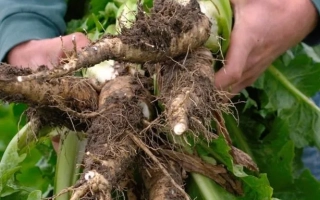
The tubers of Jerusalem artichoke have a knobby shape and measure up to 7.5-10 cm in length and 3-5 cm in diameter, resembling Irish potatoes. They possess a sweet nutty flavor comparable to artichokes and Brazil nuts. The tubers are rich in inulin — a carbohydrate that aids in sugar absorption and boosts immunity. Additionally, they contain proteins, mineral salts, B-group vitamins, vitamin C, and carotene. When heated, the tubers become tender and can serve as an alternative to potatoes.
Jerusalem artichoke is widely used as a forage crop and for silage production, and it also possesses medicinal properties. Its tubers help stabilize blood sugar levels, lower cholesterol, normalize blood pressure, and improve digestion. They support liver and kidney health, enhance absorption of iron, calcium, and magnesium, and have detoxifying effects, removing heavy metals and toxins from the body. Due to its low caloric content, Jerusalem artichoke is recommended for individuals with excess weight and obesity, and it also boosts immunity and enhances cognitive abilities.