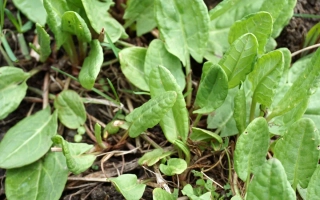
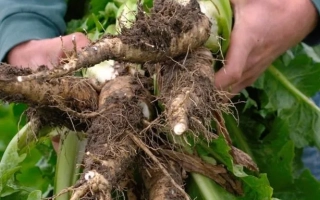
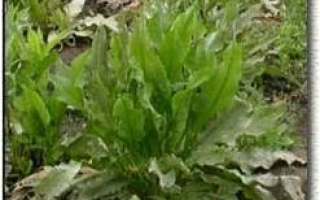
Alexandrite — a diploid chicory variety included in the State Register of the Russian Federation for cultivation zones. The plant features upright green leaves and light-green petioles. The chicory root is conical and cream-colored. The root yield reaches 550-600 centners per hectare, with dry matter content of 22.5-23.5%, and inulin content ranging from 16.0 to 18.0%. Inulin harvest reaches 8.8-10.8 centners per hectare. The variety is resistant to cercosporosis and rhizomania, and has moderate resistance to powdery mildew, making it reliable for agricultural cultivation. Alexandrite is used in both culinary and medical applications due to its beneficial properties and high-quality raw material.
Chicory variety Alexandrite contains important active substances such as beta-carotene — a natural antioxidant, vitamin E, which slows aging processes, as well as thiamin, choline, pyridoxine, riboflavin, and folic acid. Extracts from the plant are used in anti-aging cosmetic products, especially suitable for sensitive skin. The extract is a liquid ranging in color from colorless to light yellow to brown, readily soluble in water, alcohol, and propylene glycol. It has a high concentration of active substances and exerts a comprehensive effect: reduces the visibility of pigmentation spots and freckles, protects skin from free radicals, moisturizes, tones, refreshes, reduces inflammation, and imparts a healthy, even skin tone.
The Alexandrite variety was developed by Florimond Desprez and is distinguished by high dry matter content, ensuring its high efficiency in producing various products. Despite this, it is less resistant to sulfonylurea compared to other chicory varieties. Nevertheless, due to its agronomic characteristics and beneficial properties, Alexandrite is widely used in agriculture and the cosmetic industry, confirming its versatility and value.