
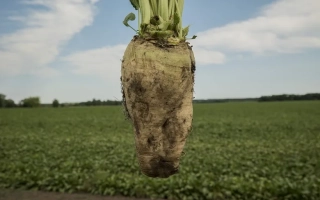

SKU #43481
·
48 views
Chereshnevyy
Sugar Beet
User rating
0 votes0% positive reviews
No ratings yet — be the first.
Root; shape
Oval-conical
Sugar Content
18-19%
Registration year
2019
About product

A high-performance variety featuring 18-19% sugar content and an ergonomic shape optimized for mechanized harvesting.
Root; shape
Oval-conical
Sugar Content
18-19%
Registration year
2019
Description
Technical Profile of the 'Chereshnevyi' Sugar Beet
The 'Chereshnevyi' variety, developed by the Institute of Bioenergy Crops and Sugar Beet of the NAAS of Ukraine, represents a strategic balance between sugar content and harvest efficiency. Its genetic design prioritizes high sucrose accumulation while maintaining structural integrity during mechanical handling.
Geometry and Agronomic Engineering
The oval-conical shape of the 'Chereshnevyi' root is not merely a morphological feature but an engineering solution for modern industrial agriculture:
- Controlled soil positioning: The root’s profile ensures optimal depth, minimizing surface exposure, which protects the crown from frost and physiological degradation.
- Optimized mechanical harvesting: The tapering lower section reduces soil resistance during the pass of harvesting equipment, significantly lowering the force required for extraction and reducing harvest losses.
- Purity of yield: The compact design minimizes the adherence of soil clods, which is critical for reducing impurities and maintaining grade standards at processing plants.
Sugar Yield as a Financial Metric
With a sugar content of 18–19%, 'Chereshnevyi' is positioned as a high-productivity variety. For sugar manufacturers, this high concentration allows for reduced energy consumption during the evaporation stage and accelerates the crystallization process. The stability of these metrics across Ukraine’s diverse soil and climate zones provides producers with a predictable and reliable yield.
Utilizing local genetics from the NAAS Institute provides farmers with a competitive edge, specifically regarding resistance to local pathogens and environmental stressors. 'Chereshnevyi' successfully merges high biological potential with ease of processing, serving as a robust standard for efficient sugar beet cultivation.
Crop & resistance
Crop
Specifications hover over for a hint about the specification
|
Root; shape
Root; shape
Roots can be round, elongated-round, cylindrical, conical. |
|
|---|---|
| Sugar Content | 18-19% |
| Registration year | 2019 |
| Catalog | Catalog → Sugar Beet |
| Legal data |
Show · 1
|
| Country | Ukraine |
Store offers
Prices are updated on loadLoading offers…
Aggregator catalog: prices are collected automatically from store websites, normalized by AI and converted at the current exchange rate. Before ordering, confirm the price and availability on the store's website. This block is not indexed by search engines — the data is loaded after the page opens.
Not yet комментариев. Be the first!
Alternatives
Sugar beet seeds · similar varieties



See also
Often considered together with this variety




Recently viewed
Products you’ve viewed on this site
Reviews · 0