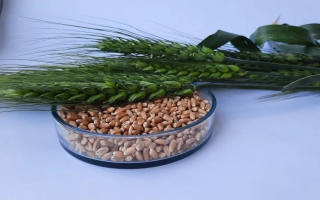
The Sotnitsia wheat variety is a high-yielding, medium-early winter soft wheat, a type of erythrospermum. It was developed by the Institute of Plant Physiology and Genetics of the National Academy of Sciences of Ukraine and registered in the Ukrainian Variety Register in 2012-2013. The variety is adapted for cultivation in steppe, forest-steppe, and forested regions, including areas such as Vinnytsia, Dnipro, Zhytomyr, Zaporizhzhia, Kirovohrad, Kyiv, Lviv, Mykolaiv, Odesa, Poltava, Rivne, Sumy, Kharkiv, and Cherkasy. Plant height is 85-100 cm, corresponding to a short-stemmed type, with an average yield of 9-11 t/ha, exceeding national standards and reaching approximately 91.2 c/ha. The variety exhibits high resistance to lodging, shattering, root rots, septoria, fusarium, brown rust, and powdery mildew, with resistance ratings ranging from 7 to 9 points. Additionally, it demonstrates high drought and stress tolerance, making it a reliable choice for various climatic conditions. The grain of the Sotnitsia variety possesses excellent baking and milling qualities, with protein content ranging from 13.6-14.1%, ensuring high product quality. To achieve maximum yield and grain quality, it is recommended to follow agronomic requirements, including a sowing rate of 5.0-6.0 million viable seeds per hectare, as well as fertilization. Specifically, applying dry nitrogen fertilizers or foliar urea applications at 10-15 kg/ha during the heading to milk ripening stage proves effective. This approach promotes improved plant development and increased yield. The Sotnitsia variety is a promising choice for intensive agriculture due to its combination of high productivity, disease and stress resistance, and superior grain quality.