


SKU #3676
·
257 views
Late Malayevskaya
Pear
User rating
0 votes0% positive reviews
No ratings yet — be the first.
Type of Sort
Autumn variety of pear
About product

A late-autumn variety with unknown pedigree, discovered during an expedition in the Volgograd Oblast in the village of Malayevka, Lenin District, Volgograd Oblast, in 1956. It was officially tested in the Volgograd Oblast since 1984.
A vigorous tree (height 5.8 m, width 5.9 m, crown volume 50.4 m3), with a broad-pyramidal, sparse crown. Main branches are thick, branching off the trunk at a 50…
Type of Sort
Autumn variety of pear
Description
A late-autumn variety with unknown pedigree, discovered during an expedition in the Volgograd Oblast in the village of Malayevka, Lenin District, Volgograd Oblast, in 1956. It was officially tested in the Volgograd Oblast since 1984.
A vigorous tree (height 5.8 m, width 5.9 m, crown volume 50.4 m3), with a broad-pyramidal, sparse crown. Main branches are thick, branching off the trunk at a 50-degree angle.
Shoots are light brown, straight, and thick. Leaves are large, with fine serrated edges, dark green, leathery, and glossy. Petioles are lightly pigmented with anthocyanin, transitioning to the central vein. Stipules are medium-sized, filamentous.
Flowers are medium-sized, with 8-9 in each inflorescence. Flower color is white. Pedicels are long, sepals are pale green, triangular, with a sharp filamentous tip. Petals are medium-sized, oval. Stamens number 22-25, white with pinkish anthers. Pistil is at the level of the anthers.
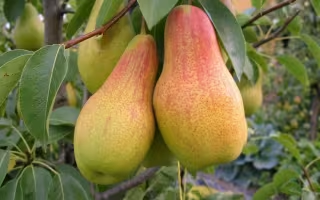
Fruits are medium to above-average size, weighing 110-225 g, irregular, short pear-shaped, dry to the touch. Skin color is yellow, with nearly all fruits uniformly pinkish blush covering 1/3 of the surface. Numerous small, rust-colored lenticels are clearly visible. Peduncle length up to 5 cm, curved, oblique, without swelling, naked, light green. Calyx is medium-sized, narrow, wrinkled, without swelling. Calyx lobes are separate, medium-sized, acute. Receptacle is of medium depth, weakly wrinkled, smooth, with pearls. Subcalyx tube is funnel-shaped, medium width and depth. Ovule is bulbous or elliptical, medium-sized, located closer to the apex, axial, symmetrical. Seed chambers are semi-lunar, closed. Seeds are ovate, dark brown.
Flesh is creamy, firm, with moderate large stone cells, juicy, slightly sour-sweet flavor, with a mild aroma. Chemical composition of the fruit: dry matter — 17.1% (14.6-18.9%), total sugars — 8.9% (6.5-10.5%), titratable acids — 0.22% (0.13-0.33%) on fresh weight, ascorbic acid — 8.7 mg/100g (6.2-12.3), sugar-acid ratio — 44.6 (31.8-71.5), polyphenols (catechins) — 8.0 mg/100g, flavonols — 14 mg/100g, total phenolic compounds — 307 mg/100g, total pectin substances — 1.13% on fresh weight.
Typical harvest period is the second half of September; consumption period lasts 30-40 days. Fruit quality is high, up to 88%. Intended use: fresh consumption and processing, primarily for compote and jam.
Best pollinators: Doctor Lucius, Astrakhan Early. Trees begin fruiting at 7-8 years of age, with high yields in some years (80-100 kg per tree), but the variety exhibits alternate bearing. Time from flowering to harvest is 135-137 days. Growing season length is 193 days.
High resistance to bacterial diseases, chlorosis, and septoria. Winter hardiness, based on laboratory-field observations, is high.
Advantages of the variety: good fruit yield and quality, high winter hardiness and disease resistance.
Disadvantages of the variety: vigorous tree growth, alternate bearing.
Crop & resistance
Crop
Disease resistance
Specifications
| Type of Sort | |
|---|---|
| Catalog | Catalog → Pear |
Store offers
Prices are updated on loadLoading offers…
Aggregator catalog: prices are collected automatically from store websites, normalized by AI and converted at the current exchange rate. Before ordering, confirm the price and availability on the store's website. This block is not indexed by search engines — the data is loaded after the page opens.
Not yet комментариев. Be the first!
Alternatives
Pear saplings · similar varieties




See also
Often considered together with this variety




Recently viewed
Products you’ve viewed on this site
Reviews · 0