


SKU #3716
·
388 views
Pear Primorsky Beauty
Pear
User rating
0 votes0% positive reviews
No ratings yet — be the first.
Type of Sort
Autumn variety of pear
Store offers · 1 from 1 stores
Prices are updated on loadLoading offers…
Available at: Садовая Деревня
Aggregator catalog: prices are collected automatically from store websites, normalized by AI and converted at the current exchange rate. Before ordering, confirm the price and availability on the store's website. This block is not indexed by search engines — the data is loaded after the page opens.
About product

Autumn variety developed by A. V. Bolonyaev and G. M. Ivanchenko at the Far Eastern Research Institute of Agriculture from a cross between Ussuri pear and Zimnaya Dekanka. In open trunk form, winter-hardy in the Southern Coastal Zone of Primorsky Krai. Grown on winter-hardy scaffold branches of Ussuri pear in other areas of Primorsky Krai and southern regions of Khabarovsk Krai, and in bush form…
Type of Sort
Autumn variety of pear
Description
Autumn variety developed by A. V. Bolonyaev and G. M. Ivanchenko at the Far Eastern Research Institute of Agriculture from a cross between Ussuri pear and Zimnaya Dekanka. In open trunk form, winter-hardy in the Southern Coastal Zone of Primorsky Krai. Grown on winter-hardy scaffold branches of Ussuri pear in other areas of Primorsky Krai and southern regions of Khabarovsk Krai, and in bush form with winter covering in collective and backyard gardens in more northern areas of Khabarovsk Krai, as well as in the Jewish Autonomous, Amur, and Sakhalin regions.
Medium-sized tree, round-pyramidal in shape, with scaffold branches emerging compactly at right angles. Medium-density crown, bark light brown with greenish tint.
Shoots are greenish-brown, slightly curved, medium thickness, with small lenticels. Internodes are medium length. Buds are relatively large, rounded-acute, greenish-brown with slight deviation. Leaves are medium-sized, elongated, slightly curved, without pubescence; upper leaf surface is dark green, lower surface pale green.
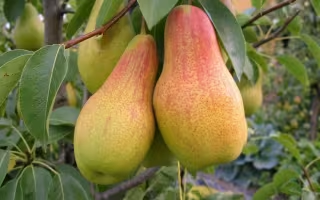
Fruits are small (average weight 54 g, maximum 75 g), oval in shape with slight taper toward the peduncle, one-dimensional. Skin is smooth, slightly oily. Main color is yellowish-green or yellow, with a light russet bloom and numerous subcutaneous dots. Peduncle is medium length and thickness, greenish-brown. Bore is small or slightly raised. Calyx is shallow.
Flesh is white, semi-oily, juicy, slightly tart-sweet with aroma.
Fruits contain dry matter — 18.7%, total sugars — 13.3%, titratable acids — 0.9%, tannins — 0.6%, pectins — 0.5%, ascorbic acid — 3.8 mg/100g, vitamin P — 199-240 mg/100g.
Fruits ripen at the end of August — beginning of September. Stored fresh for up to one month.
Fruits suitable for making compotes, pickles, jams, and preserves…
Trees begin fruiting 3-4 years after grafting. Annual fruiting with alternating high and medium yields. Commercial yields up to 30-40 centners per hectare. At ages 5-6 years — 6-8 kg, and at 11 years — 45 kg of fruit per tree. The variety is resistant to diseases.
Advantages of the variety: one of the best varieties on the Far East for fruit flavor, resistant to scab, annual yield.
Disadvantages of the variety: insufficient winter hardiness of trees, limiting its cultivation in commercial plantations to relatively small areas in the Southern Coastal Zone of Primorsky Krai.
Crop & resistance
Crop
Disease resistance
Specifications
| Type of Sort | |
|---|---|
| Catalog | Catalog → Pear |
Not yet комментариев. Be the first!
Alternatives
Pear saplings · similar varieties


See also
Often considered together with this variety



Recently viewed
Products you’ve viewed on this site
Reviews · 0