


SKU #3735
·
789 views
Sverdlovchanka
Pear
User rating
2 votes100% positive reviews
No ratings yet — be the first.
Type of Sort
Autumn variety of pear
Store offers · 3 from 3 stores
Prices are updated on loadLoading offers…
Available at: Центросад (CentroSad) · Сад от А до Я · Самые топовые сорта растений и семян в нашем интернет магазине/ бережная доставка по РФ · Zelenaya Volna
Aggregator catalog: prices are collected automatically from store websites, normalized by AI and converted at the current exchange rate. Before ordering, confirm the price and availability on the store's website. This block is not indexed by search engines — the data is loaded after the page opens.
About product

Autumn-summer variety from the Sverdlovsk and Saratov Experimental Stations of Fruit Growing. Obtained by pollinating Polya 'Lukashovka' with pollen from southern varieties. Authors: L. A. Kotov, G. V. Kondratyeva. Approved for the Lower Volga region. Undergoing State Variety Testing in the Urals and the Volga-Vyatka region. Gained particular popularity in the Saratov region, where it proved itse…
Type of Sort
Autumn variety of pear
Description
Autumn-summer variety from the Sverdlovsk and Saratov Experimental Stations of Fruit Growing. Obtained by pollinating Polya 'Lukashovka' with pollen from southern varieties. Authors: L. A. Kotov, G. V. Kondratyeva. Approved for the Lower Volga region. Undergoing State Variety Testing in the Urals and the Volga-Vyatka region. Gained particular popularity in the Saratov region, where it proved itself as one of the best varieties. Has prospects for wider cultivation.
Medium-sized tree with a broad-pyramidal or round crown. Main branches with greenish-dark-gray bark are raised upward, densely covered with branched rings, on which fruiting is concentrated starting from two-year-old wood and on last year's growths.
Shoots with greenish-brown bark, straight, not grooved. Leaves dark green, shiny, elliptical or egg-shaped, flat or slightly folded, with finely toothed edges, long petioles, and small sickle-shaped stipules.
Flowers of medium size, white, cup-shaped. Stigmas are located at the height of the anthers. Flowering is late.
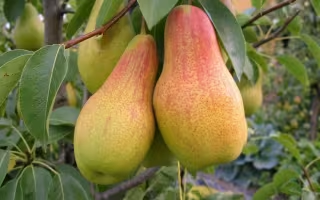
Fruits of medium size (average weight 140 g, maximum 180 g), ranging from elongated-pear to short-pear shapes, with smooth surface. Color is green when harvested, turning yellowish upon ripening, often with a slight blush on the sun-exposed side. Peduncle is long, receptacle small but fairly wide, calyx open. Heart-shaped core, seed chambers closed.
Flesh is white with a yellowish tint, very juicy, tender, thin, oily type, practically without granules, pleasantly acidic-sweet flavor, aromatic. Sugar content — 9.9%, titratable acids — 0.2%.
In the Sverdlovsk region, this is an autumn-ripening variety consumed in September–October. In the Saratov region, Sverdlovchanka becomes a summer dessert variety with more intense yellow coloring.
Fruits have good market appearance, firmly hold on the tree, and are quite transportable.
Self-sterile. Well-pollinated by other pear varieties.
Trees are precocious, begin fruiting on the fourth year after grafting, quickly increase yield. Fruit production is abundant and regular. High productivity — over 200 centners per hectare.
Overall winter hardiness is high, but at northern boundaries of its distribution area — medium, so here it should be grown on rootstocks of cold-resistant standards and framework-forming varieties (Ussuri pear and its hybrids). The variety is not affected by fungal diseases.
Advantages of the variety: dessert flavor of fruits, large fruit size, high yield, winter hardiness, disease resistance.
Disadvantages of the variety: medium winter hardiness at the northern edge of its distribution area.
Video · 5 videos
Suggest a video →Crop & resistance
Crop
Disease resistance
Specifications
| Type of Sort | |
|---|---|
| Catalog | Catalog → Pear |
Not yet комментариев. Be the first!
Alternatives
Pear saplings · similar varieties




See also
Often considered together with this variety



Recently viewed
Products you’ve viewed on this site
Reviews · 0