


SKU #3584
·
650 views
Apple Alenushka (Dumpling)
Pear
Type of Variety
Autumn variety of pear
Your mark
0 votes
0% positive ratings
Store offers · 2 from 2 stores
2 offers in 2 stores — from 4.4 € per seedling.
Available at: Саженцы и черенки · Agromir
Prices are collected automatically from store websites and converted at the current exchange rate. Check the price and availability on the store website before ordering.
Description
Late autumn variety selected at the Rossohskaya Zonal Experimental Station for Horticulture. Breeders: A. M. Ulyanishcheva, O. V. Riazantseva. Parental forms: Bere Winter Michurin's mix of pollen from 8 varieties (Lesnaya Krasavitsa, Josefine Mechelenska, Triumph Joduan, Angoustrine Krasavitsa, Dusch Angouleme, Dekanka Winter, Cure, St. Germain). Approved in the Central Chernozem Zone.
Tree is weak-growing. Crown is sparse, round-shaped, slightly drooping. Bark of the trunk is light gray. Main branches are gray, branch at right angles from the trunk.
Shoots are brownish-brown, straight, round in cross-section, hairless. Buds are medium-sized. Buds are oblique, conical, brown. Leaves are medium-sized, egg-shaped, green, slightly pointed. Leaf margin is finely toothed. Leaf blade is smooth, flat, curved upwards, hairless. Petiole length is medium. Inflorescence is a flat-topped umbel. Flowers are small, shallow-cup-shaped, white, slightly double.
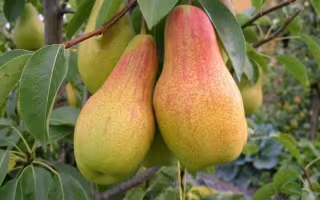
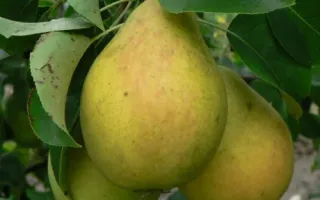
Fruits are above average size (average mass 160 g), short pear-shaped. Main color at consumer maturity is golden-yellow, with a mostly blurred raspberry-red covering. Fruit surface is smooth. Skin is thin. Subcutaneous spots are medium-sized. Peduncle is medium in length and thickness. Calyx is narrow, small. Receptacle is medium depth. Calyx tube is half-open. Subcalyx tube is medium. Heart is medium. Seeds are medium-sized, brown.
Fruit flesh is cream-white, slightly tart-sweet, oily, very juicy, very tender. Appearance rating: 4.7 points, taste rating: 4.6 points.
Fruits contain: Pectin — 17.04%, titratable acids — 0.23%, sugars — 10.1%, pectin substances — 0.65%, ascorbic acid — 8.1 mg/100g, catechins — 114.8 mg/100g. Sugar-acid ratio is 43.9.
According to harvest time, the variety is medium-early ripening; according to consumer maturity, it is autumn or late autumn.
Age of fruiting onset is medium. Yield of 11-15-year-old trees averaged 174 centners per hectare. Fruit production is regular. Self-sterile. Fruit transportability is high. Average storage life of fruit during study period — 80 days, maximum — 113 days.
The variety has relatively high winter hardiness. Tolerates temperatures down to -38°C in mid-winter, down to -25°C after sudden temperature drop following thaw, down to -33°C after thaw and subsequent hardening by negative temperatures.
High drought resistance in both young and fruiting stages. Adequate heat tolerance.
Slightly affected by septoria — 0.5–1.3 points. Not affected by scab. In nursery, affected by Entomosporium up to 2.5 points. Heavily damaged by pear aphid.
Advantages of the variety: weak-growing trees, relatively high winter hardiness for the southern part of the Central Chernozem Zone, resistance to scab, attractive, tasty fruits.
Disadvantages of the variety: leaf infection by Entomosporium in nursery.
Crop & resistance
Crop
Specifications
| Type of Variety | |
|---|---|
| Catalog | Catalog → Pear |
No reviews yet. Be the first to share your experience.
Alternatives
Pear saplings · similar varieties




See also
Often considered together with this variety


Recently viewed
Products you’ve viewed on this site
Reviews