

SKU #46057
·
88 views
Grape Carbonado
Grape
User rating
0 votes0% positive reviews
No ratings yet — be the first.
Ripening Period
Early, Medium
Cold Resistance
Very High (up to -27°C)
Resistance to Mildew
Average
Resistance to oidium
Average
Prices in stores
from4.85 €per seedling
pack from 3.87 € per pack
2 offers from 2 stores
Store offers · 2 from 2 stores
Prices are updated on loadLoading offers…
Available at: Sezon · Vinograd Odessa
Aggregator catalog: prices are collected automatically from store websites, normalized by AI and converted at the current exchange rate. Before ordering, confirm the price and availability on the store's website. This block is not indexed by search engines — the data is loaded after the page opens.
About product

Carbonado grape is a hybrid variety obtained by crossing Talisman and Black Winter Kishmish varieties. This variety is characterized by early to mid-season ripening, occurring from September 10 to 25 in the Kyiv region. The vines are vigorous with strong upright shoots and high fruiting capacity — 2-3 clusters form on each shoot. The flower is bisexual, ensuring good pollination and practically no…
Ripening Period
Early, Medium
Cold Resistance
Very High (up to -27°C)
Resistance to Mildew
Average
Resistance to oidium
Average
Description
Carbonado grape is a hybrid variety obtained by crossing Talisman and Black Winter Kishmish varieties. This variety is characterized by early to mid-season ripening, occurring from September 10 to 25 in the Kyiv region. The vines are vigorous with strong upright shoots and high fruiting capacity — 2-3 clusters form on each shoot. The flower is bisexual, ensuring good pollination and practically no berry drop in clusters.
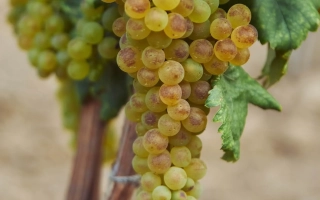
The berries of Carbonado are large, oval or round, black or dark-blue in color with a dense powdery bloom. The weight of one berry ranges from 8 to 12 grams, the flesh is firm and crisp, the juice is colorless. The taste is harmonious with a good balance of sugar and acid, and upon full ripening, a slight blackcurrant flavor appears. The sugar content of the juice reaches 19–21 %, acidity is slightly elevated — about 5.7 g/l. The clusters are loose, weighing from 500 to 1200 grams, sometimes reaching 1.5–2 kg. Berry coloring within the clusters is even, although under overloading, the lower part of the cluster may color less intensely.
The variety is characterized by high frost resistance — it withstands temperatures down to –28 °C, with bud survival after such frosts reaching 80 %. Resistance to major diseases is high, susceptibility to mildew and oidium is rated 2.0–3.0, which allows nearly complete avoidance of diseases by the end of the season with three preventive treatments using systemic agents. The grape roots easily and exhibits high drought tolerance, recommended for cultivation on its own roots or on low- and medium-vigor rootstocks. The yield of this variety is very high — on trellis training it reaches up to 16.8 t/ha, and on arched structures it can reach 25–30 t/ha. For optimal ripening and to reduce vertical shoot polarity, arched training is recommended, along with yield regulation, leaving one cluster per shoot.
The berries of Carbonado are large, oval or round, black or dark-blue in color with a dense powdery bloom. The weight of one berry ranges from 8 to 12 grams, the flesh is firm and crisp, the juice is colorless. The taste is harmonious with a good balance of sugar and acid, and upon full ripening, a slight blackcurrant flavor appears. The sugar content of the juice reaches 19–21 %, acidity is slightly elevated — about 5.7 g/l. The clusters are loose, weighing from 500 to 1200 grams, sometimes reaching 1.5–2 kg. Berry coloring within the clusters is even, although under overloading, the lower part of the cluster may color less intensely.
The variety is characterized by high frost resistance — it withstands temperatures down to –28 °C, with bud survival after such frosts reaching 80 %. Resistance to major diseases is high, susceptibility to mildew and oidium is rated 2.0–3.0, which allows nearly complete avoidance of diseases by the end of the season with three preventive treatments using systemic agents. The grape roots easily and exhibits high drought tolerance, recommended for cultivation on its own roots or on low- and medium-vigor rootstocks. The yield of this variety is very high — on trellis training it reaches up to 16.8 t/ha, and on arched structures it can reach 25–30 t/ha. For optimal ripening and to reduce vertical shoot polarity, arched training is recommended, along with yield regulation, leaving one cluster per shoot.
Video · 4 videos
Suggest a video →Crop & resistance
Crop
Disease resistance
Specifications hover over for a hint about the specification
|
Ripening Period
Ripening Period
It takes 70-100 days until pepper reaches flowering stage, 130-160 days until technical fruit ripeness, and 135-180 days until physiological ripeness. |
Early, Medium |
|---|---|
| Cold Resistance | |
| Resistance to Mildew | |
| Resistance to oidium | |
|
Yield
Yield
Overall bulb harvest per unit area. Depends on both onion variety characteristics and agronomic practices, fertilizers, and irrigation. Under optimal growing conditions, an onion yield of 100 tons per hectare and above is not considered record-breaking. |
High |
| Bush Growth Power | |
| Flower Type | |
| Bunch Size | Large (500–800 g) |
| Berry Size | Large (5–8 g) |
| Berry Color | |
| Flavor | |
| Sugar Content | Average (16–20%) |
| Assignment | |
| Features | |
| Registration year | 2021 |
| Catalog | Catalog → Grape |
| Country | Ukraine |
Not yet комментариев. Be the first!
Alternatives
Grapevine saplings · similar varieties

EXPECTED
Фгбоу Во Кубанский Государственный Аграрный Университет Имени И.Т.Трубилина
049 10 offers
2.58 €per seedling ≈ 132 ₴

ROSHFOR K
Фгбоу Во Кубанский Государственный Аграрный Университет Имени И.Т.Трубилина
048 7 offers
3.78 €per seedling ≈ 194 ₴


TEACHER'S MEMORY
ФГБОУ ВО Омский государственный аграрный университет имени П.А. Столыпина
063 8 offers
2.42 €per seedling ≈ 124 ₴

See also
Often considered together with this variety




Recently viewed
Products you’ve viewed on this site
Reviews · 0