
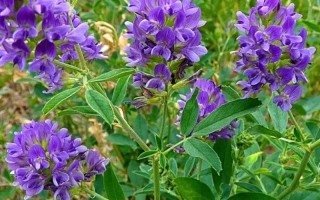


SKU #68551
·
49 views
Alfalfa YAKUTIA YELLOW
Lucerne
User rating
0 votes0% positive reviews
No ratings yet — be the first.
Plant Height
60-100
Registration year
1989
About product

An extremely winter-hardy variety designed for stable forage production in harsh climates.
Plant Height
60-100
Registration year
1989
Description
Genetic Potential for Northern Adaptation
The 'Yakutskaya Zhelthaya' alfalfa variety is the result of selective breeding by the Federal Research Center Yakut Scientific Center of the SB RAS. The primary technological value of this material lies in its extreme winter hardiness, which is essential for regions with critical temperature lows. Unlike southern varieties, this genetic type features increased cell membrane density, preventing cellular damage during deep freezing.
Morphological Indicators and Productivity
Under field conditions, the plant demonstrates stable growth metrics, reaching heights of 60 to 100 cm. A key physiological feature is its ability to maintain vegetative activity under short daylight hours and low cumulative active temperatures. This makes the variety a reliable tool for establishing a stable forage base in harsh climatic zones.
Production Significance
- Bush Architecture: A height of up to one meter provides an optimal volume of green mass for mechanized harvesting.
- Breeding Focus: Originators (Maksimova Z. I., Soromotina A. A., Yakovlev A. S.) focused on adaptation to Yakutian soils, ensuring yield predictability when standard agricultural practices are followed.
- Intellectual Property: The patent holder, Yakut Research Institute of Agriculture named after M.G. Safronov, ensures line purity and strict adherence to varietal characteristics.
The practical application of this variety is most justified in hayfields and pastures requiring long-term stand durability and rapid regrowth after mowing within short growing seasons.
Crop & resistance
Crop
Specifications
| Plant Height | 60-100 |
|---|---|
| Registration year | 1989 |
| Catalog | Catalog → Lucerne |
| Legal data |
Show · 6
|
| Country | Russia |
Store offers
Prices are updated on loadLoading offers…
Aggregator catalog: prices are collected automatically from store websites, normalized by AI and converted at the current exchange rate. Before ordering, confirm the price and availability on the store's website. This block is not indexed by search engines — the data is loaded after the page opens.
Not yet комментариев. Be the first!
Alternatives
Alfalfa seeds · similar varieties


See also
Often considered together with this variety



Recently viewed
Products you’ve viewed on this site
Reviews · 0