


SKU #71428
·
55 views
TULUNSKY
Brome Grass
User rating
0 votes0% positive reviews
No ratings yet — be the first.
Assignment
Feed
Type
Perennial
Plant Height
100-120
Registration year
1971
Prices in stores
from7.87 €per 1 kg
pack from 1.18 € per 150 g
1 offer from 1 store
Store offers · 1 from 1 stores
Prices are updated on loadLoading offers…
Available at: Семена Оптом
Aggregator catalog: prices are collected automatically from store websites, normalized by AI and converted at the current exchange rate. Before ordering, confirm the price and availability on the store's website. This block is not indexed by search engines — the data is loaded after the page opens.
About product

Brome grass «Tulunsky» – a perennial grass from the grass family, hairless (Bromus inermis Leyss.). It was bred at the Siberian Research Institute of Agriculture and Forestry by the method of group biotypic selection from a wild population K 3431, VIR. The bush is erect, dense, 110-140 cm high, with round stems of medium coarseness and without pubescence. A light anthocyanin coloration is observed…
Assignment
Feed
Type
Perennial
Plant Height
100-120
Registration year
1971
Description
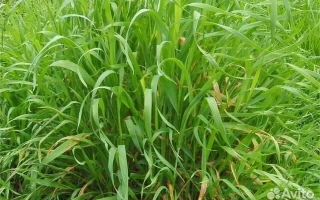
Brome grass «Tulunsky» – a perennial grass from the grass family, hairless (Bromus inermis Leyss.). It was bred at the Siberian Research Institute of Agriculture and Forestry by the method of group biotypic selection from a wild population K 3431, VIR. The bush is erect, dense, 110-140 cm high, with round stems of medium coarseness and without pubescence. A light anthocyanin coloration is observed at the nodes of the stems.
The leaves of brome grass «Tulunsky» have a wide-linear shape, 25-40 cm long and 1.0-2.5 cm wide, covered with a weak waxy coating. They are evenly distributed along the stem, dark green in color and slightly soft. The inflorescence is a panicle 25-32 cm long, initially compressed, then spreading, colored dark-gray. Floral scales are hairless, and seeds are of medium size, strongly flattened, 10-12 mm long, gray-purple in hue.
The fodder value of brome grass is high: the weight of 1000 seeds ranges from 3.1 to 3.9 g. In the Middle-Volga region, the average yield of dry matter reached 54.3 c/ha, and in East-Siberia – 39.6 c/ha. The maximum seed yield indicators were recorded in Irkutsk Oblast (11.7 c/ha) and at the State Experimental Station of the Republic of Mordovia (5.8 c/ha). The vegetative period lasts from the beginning of spring growth to the first mowing – 67-73 days, and to economic maturity of seeds – 97-112 days. Brome grass «Tulunsky» is widely used in farming enterprises as part of the animal feeding system and for sowing fodder crops, providing a stable source of nutrients for livestock.
The leaves of brome grass «Tulunsky» have a wide-linear shape, 25-40 cm long and 1.0-2.5 cm wide, covered with a weak waxy coating. They are evenly distributed along the stem, dark green in color and slightly soft. The inflorescence is a panicle 25-32 cm long, initially compressed, then spreading, colored dark-gray. Floral scales are hairless, and seeds are of medium size, strongly flattened, 10-12 mm long, gray-purple in hue.
The fodder value of brome grass is high: the weight of 1000 seeds ranges from 3.1 to 3.9 g. In the Middle-Volga region, the average yield of dry matter reached 54.3 c/ha, and in East-Siberia – 39.6 c/ha. The maximum seed yield indicators were recorded in Irkutsk Oblast (11.7 c/ha) and at the State Experimental Station of the Republic of Mordovia (5.8 c/ha). The vegetative period lasts from the beginning of spring growth to the first mowing – 67-73 days, and to economic maturity of seeds – 97-112 days. Brome grass «Tulunsky» is widely used in farming enterprises as part of the animal feeding system and for sowing fodder crops, providing a stable source of nutrients for livestock.
Crop & resistance
Crop
Specifications hover over for a hint about the specification
| Assignment | |
|---|---|
|
Type
Type
Galia (Galia) type — relatively new, of Israeli origin, although there are indications that this variety may originate from Spain. The fruits of this type are round or oval, weighing about 1 kg. The surface is smooth, covered with a delicate, connected netting, turning yellow whe... |
|
| Plant Height | 100-120 |
| Registration year | 1971 |
| Catalog | Catalog → Brome Grass |
| Legal data |
Show · 9
|
| Country | Russia |
Not yet комментариев. Be the first!
Alternatives
Brome Grass · similar varieties


See also
Often considered together with this variety


Recently viewed
Products you’ve viewed on this site
Reviews · 0