Viburnum 'SOUZGA' is a variety bred at the Siberian Institute of Vegetable and Fruit Growing (NIISS) and included in the State Register in 1995; it is available in all regions of the country. The bush reaches a height of up to 3.5 m, has a compact structure with monopodial-symphodial branching, and shoots are smooth and light green. Leaves are three- and five-lobed, dark green, and arranged oppositely.
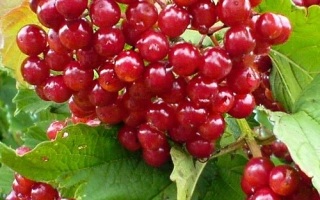
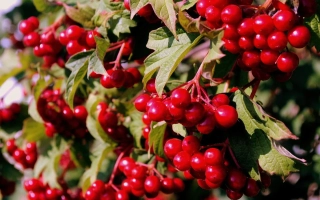
Fruits of the 'SOUZGA' variety are spherical, crimson-red, and of medium mass, about 0.65 g. The flesh is juicy and slightly bitter, making the berries pleasant to eat. They contain a significant amount of vitamins: vitamin C — 138 mg/100 g, vitamin P (pantothenic acid) — 585 mg/100 g, as well as sugars and acids in a ratio of 10.1 : 2.0. The taste score reaches 3.8 points.
The variety is characterized by high yield – up to 7.1 kg per bush (or 83.3 c/ha at the Novosibirsk Research Institute of Agriculture) and good winter hardiness, which allows its use in various climatic conditions. However, in dry years, yield may decrease, and fruits sometimes exhibit noticeable bitterness. For optimal growth, irrigation or planting in soils with natural moisture is recommended. Viburnum 'SOUZGA' is valued as a decorative shrub and is widely used in medicine, folk traditions, and horticulture due to its beneficial properties.