


SKU #46062
·
247 views
Cobere 5BB 211161
Grape
User rating
0 votes0% positive reviews
No ratings yet — be the first.
Ripening Period
Late
Yield
High
Bush Growth Power
Strong
Flower Type
Female
About product

Cobere 5BB — this is an old and widely used grapevine rootstock, created by crossing wild American species in 1886 by the French agronomist Évrard Rességuie. The resulting seeds were sent to the Hungarian viticulturist Teleki, who planted 40,000 seedlings, and selected specimens were sent in 1904 to the Austrian viticulture inspector Cobere, who systematized the rootstocks and gave them names. Thi…
Ripening Period
Late
Yield
High
Bush Growth Power
Strong
Flower Type
Female
Description
Cobere 5BB — this is an old and widely used grapevine rootstock, created by crossing wild American species in 1886 by the French agronomist Évrard Rességuie. The resulting seeds were sent to the Hungarian viticulturist Teleki, who planted 40,000 seedlings, and selected specimens were sent in 1904 to the Austrian viticulture inspector Cobere, who systematized the rootstocks and gave them names. This rootstock is characterized by vigorous bushes with long, straight, and spreading shoots, a powerful root system that penetrates deeply into the soil up to 7 meters, and high resistance to phylloxera. The cane matures by 80%, and the bud winter hardiness and root frost resistance are sufficiently high, making Cobere 5BB a reliable choice for southern regions.
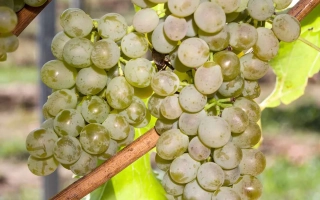
External characteristics of the rootstock include a purple-red bud with a grayish-fuzzy tuft, a green young shoot tip with a bronze-red tint and dense tufting, as well as large, round or slightly elongated three-lobed leaves with a dense, leathery dark green blade. The leaves have characteristic petiole notches in the shape of the Latin letter V, weakly expressed indentations and teeth of various shapes. The flower is functionally female, and the clusters are small, cylindrical-conical, and loose. The berries are small, round, black with a bluish tint, and contain 3-4 small seeds.
Agrobiological characteristics of the rootstock include a late ripening period, shoot length up to 4-5 meters, and a vegetative period of about 180 days at an accumulated active temperature sum of 3250 °C. Cobere 5BB promotes increased growth of the scion shoots and increases the average cluster and berry weight, positively affecting yield. However, on very fertile soils, it may cause excessive growth, which worsens berry coloring and cane maturation. The rootstock is well-suited for light, permeable soils and is not recommended for varieties prone to flower drop during flowering.
External characteristics of the rootstock include a purple-red bud with a grayish-fuzzy tuft, a green young shoot tip with a bronze-red tint and dense tufting, as well as large, round or slightly elongated three-lobed leaves with a dense, leathery dark green blade. The leaves have characteristic petiole notches in the shape of the Latin letter V, weakly expressed indentations and teeth of various shapes. The flower is functionally female, and the clusters are small, cylindrical-conical, and loose. The berries are small, round, black with a bluish tint, and contain 3-4 small seeds.
Agrobiological characteristics of the rootstock include a late ripening period, shoot length up to 4-5 meters, and a vegetative period of about 180 days at an accumulated active temperature sum of 3250 °C. Cobere 5BB promotes increased growth of the scion shoots and increases the average cluster and berry weight, positively affecting yield. However, on very fertile soils, it may cause excessive growth, which worsens berry coloring and cane maturation. The rootstock is well-suited for light, permeable soils and is not recommended for varieties prone to flower drop during flowering.
Crop & resistance
Crop
Disease resistance
Pest resistance
Specifications hover over for a hint about the specification
|
Ripening Period
Ripening Period
It takes 70-100 days until pepper reaches flowering stage, 130-160 days until technical fruit ripeness, and 135-180 days until physiological ripeness. |
Late |
|---|---|
|
Yield
Yield
Overall bulb harvest per unit area. Depends on both onion variety characteristics and agronomic practices, fertilizers, and irrigation. Under optimal growing conditions, an onion yield of 100 tons per hectare and above is not considered record-breaking. |
High |
| Bush Growth Power | |
| Flower Type | |
| Bunch Size | Small (up to 300 g) |
| Berry Size | Fine (<2 g) |
| Berry Color | |
| Zoning | |
| Registration year | 2021 |
| Catalog | Catalog → Grape |
| Legal data |
Show · 4
|
| Country | Ukraine |
Store offers
Prices are updated on loadLoading offers…
Aggregator catalog: prices are collected automatically from store websites, normalized by AI and converted at the current exchange rate. Before ordering, confirm the price and availability on the store's website. This block is not indexed by search engines — the data is loaded after the page opens.
Not yet комментариев. Be the first!
Alternatives
Grapevine saplings · similar varieties




See also
Often considered together with this variety


Recently viewed
Products you’ve viewed on this site
Reviews · 0