


SKU #46402
·
64 views
Shans
Cherry, Sour Cherry
User rating
0 votes0% positive reviews
No ratings yet — be the first.
Ripening Period
Early (second decade of June)
Fruit Color
Dark Red
Fruit Size
Large (6–8 g)
Flavor
Sweet
Store offers · 4 from 2 stores
Prices are updated on loadLoading offers…
Available at: Сады Семирамиды · Світ Рослин
Aggregator catalog: prices are collected automatically from store websites, normalized by AI and converted at the current exchange rate. Before ordering, confirm the price and availability on the store's website. This block is not indexed by search engines — the data is loaded after the page opens.
About product

A high-yielding variety with superior disease resistance and easy-to-manage canopy growth.
Ripening Period
Early (second decade of June)
Fruit Color
Dark Red
Fruit Size
Large (6–8 g)
Flavor
Sweet
Description
Operational characteristics of the 'Shans' cherry
The 'Shans' cherry, developed by the M.F. Sydorenko Institute, is designed for growers who prioritize predictability and high output with minimal maintenance. Its medium-sized growth habit ensures manageable canopy geometry, allowing for pruning and harvesting without heavy machinery. Most maintenance tasks can be completed using standard ladders, reducing labor costs significantly.
Pest management and resilience
A key operational advantage of this variety is its genetic resistance to shot-hole disease (clasterosporiosis) and coccomycosis. In humid climates, where disease pressure is high, 'Shans' requires fewer fungicide applications than more sensitive European varieties, directly lowering chemical input costs and simplifying the spray schedule.
Harvesting and processing
The harvest window opens in the second decade of June. Yields are robust, consistently reaching 25–40 kg per tree. The 6–8g dark-red fruits are firm enough for transport when properly cooled. For producers focused on processing (jams or preserves), the variety is highly efficient: the stone detaches easily, minimizing manual labor time during pitting operations.
- Growth: Medium-stature tree, low-impact maintenance.
- Fruit quality: Sweet, juicy flesh with excellent market presentation.
- Use case: Balanced performance for both fresh market retail and industrial canning.
Specifications hover over for a hint about the specification
|
Ripening Period
Ripening Period
It takes 70-100 days until pepper reaches flowering stage, 130-160 days until technical fruit ripeness, and 135-180 days until physiological ripeness. |
Early (second decade of June) |
|---|---|
| Fruit Color | |
| Fruit Size | Large (6–8 g) |
| Flavor | |
| Flesh Firmness | |
| Core | |
| Disease Resistance | |
|
Yield
Yield
Overall bulb harvest per unit area. Depends on both onion variety characteristics and agronomic practices, fertilizers, and irrigation. Under optimal growing conditions, an onion yield of 100 tons per hectare and above is not considered record-breaking. |
High (25–40 kg) |
| Tree Growth Power | |
| Assignment | |
| Features | |
| Registration year | 2007 |
| Catalog | Catalog → Cherry, Sour Cherry |
| Legal data |
Show · 1
|
| Country | Ukraine |
Not yet комментариев. Be the first!
Alternatives
Cherry saplings · similar varieties


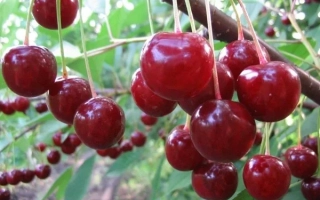
Vavilov Memory Cherry
All-Russian scientific-research institute
065 5 offers
3.35 €per seedling ≈ 173 ₴


See also
Often considered together with this variety



Recently viewed
Products you’ve viewed on this site
Reviews · 0