

SKU #46704
·
89 views
Buckwheat Victoria
Buckwheat
Prices in stores
No offers yet — stores have not added prices for this product yet.
Similar varieties with prices
-
DEVIATKA
from 0.89 €per 1 kg
-
 Krupinka
from 0.4 €per 1 kg
Krupinka
from 0.4 €per 1 kg
-
 Sin-3/02
from 0.59 €per 1 kg
Sin-3/02
from 0.59 €per 1 kg
-
 RubraPodilskyi DATU
from 2.47 €за л
RubraPodilskyi DATU
from 2.47 €за л
Plant Height
90-100 cm
Growing Season
70-80 days
Registration year
1969
Your mark
1 vote
100% positive ratings
Description
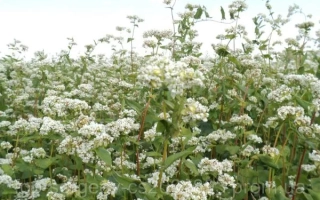
The buckwheat variety Victoria was developed at the Institute of Agriculture and Animal Husbandry of the Western Region of UAAN and the Ternopil Regional Agricultural Station using selection by seed shape and size from a local variety of the Ternopil region, followed by pollination with the best local varieties from the Lviv region and pedigree group selection. The variety was officially released in 1969 and belongs to the vulgaris subspecies, the alata variety. It is a medium-maturing variety with a vegetation period of 75-90 days, flowering begins on day 28-30. Plants reach a height of 90-100 cm, have approximately 10 nodes on the stem and 4-6 branches, of which 3-4 are first-order. Flowers and buds are pale pink, medium-sized, with uniform flowering.
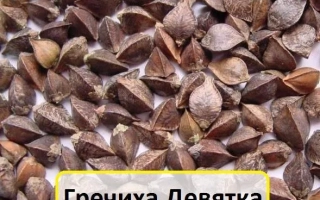
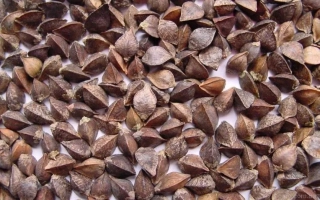
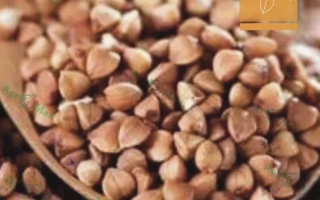
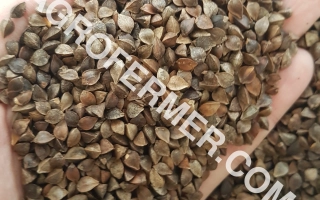
The fruits of the Victoria variety are medium-sized with weakly expressed wings, brown with a grayish tint, slightly elongated at the tip. The 1000-grain weight ranges from 23-28 g, the natural density is 608-645 g/L, the uniformity is 64-76%, the hull content is 20-22%, and the grain yield reaches 69-74%. The grain contains protein at a level of 15.5-18.0%, with high levels of lysine (7 g/100 g), arginine (11.4 g/100 g), and tryptophan (1.75 g/100 g). The total content of essential amino acids is 43.0%. In addition, the grain contains 3.4-3.5% fat and 74% starch, which has a high amyloglucosidase content (28.5%), affecting the quality of the starch.
The buckwheat porridge from the Victoria variety is fluffy and has excellent taste qualities. The variety is characterized by high yield, with maximum yield reaching 38.5 centners per hectare. Due to its agronomic and nutritional characteristics, the variety can be grown in intercropping systems, expanding its application in agriculture.
The fruits of the Victoria variety are medium-sized with weakly expressed wings, brown with a grayish tint, slightly elongated at the tip. The 1000-grain weight ranges from 23-28 g, the natural density is 608-645 g/L, the uniformity is 64-76%, the hull content is 20-22%, and the grain yield reaches 69-74%. The grain contains protein at a level of 15.5-18.0%, with high levels of lysine (7 g/100 g), arginine (11.4 g/100 g), and tryptophan (1.75 g/100 g). The total content of essential amino acids is 43.0%. In addition, the grain contains 3.4-3.5% fat and 74% starch, which has a high amyloglucosidase content (28.5%), affecting the quality of the starch.
The buckwheat porridge from the Victoria variety is fluffy and has excellent taste qualities. The variety is characterized by high yield, with maximum yield reaching 38.5 centners per hectare. Due to its agronomic and nutritional characteristics, the variety can be grown in intercropping systems, expanding its application in agriculture.
Specifications
| Plant Height | 90-100 cm |
|---|---|
| Growing Season | 70-80 days |
| Registration year | 1969 |
| Catalog | Catalog → Buckwheat |
| Legal data |
Show · 1
|
| Country | Ukraine |
No reviews yet. Be the first to share your experience.
Alternatives
Buckwheat seeds · similar varieties




See also
Often considered together with this variety




Recently viewed
Products you’ve viewed on this site
Reviews