Late-season variety obtained at the Siberian Institute of Horticulture named after M. A. Lisavensky in 1959 by crossing the early variety Severyanka with Melba and Belphler-Chinese (pollen mixture). Breeders: M. A. Lisavensky, L. Yu. Zhebrovskaya, I. P. Kalinina, T. F. Kornienko, and Z. A. Granikina. Widely grown in the Altai region. Approved in 1988 for the Ural, West Siberian, and Far Eastern regions.
Medium-sized trees with round, sparse, compact crowns. Main branches are large, oblique-vertical, gray-brown, with evenly spaced simple and compound rings, where fruiting is concentrated.
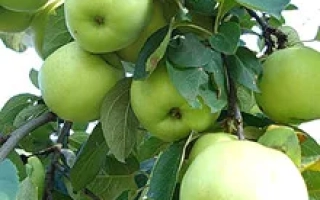
Shoots are shortened, curved, round in cross-section, with short internodes, brown, weakly hairy. Leaves are large, ovate, curved along the central vein, elastic, matte, dark green, with doubly toothed wavy margins, hairy on the underside. Petioles of medium length with lanceolate stipules.
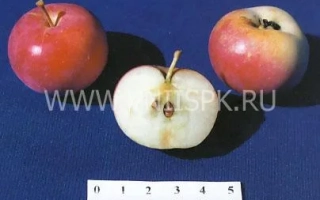
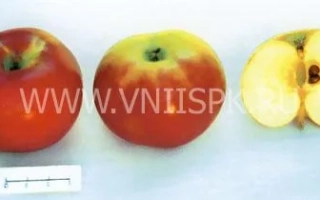
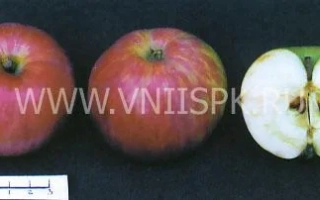
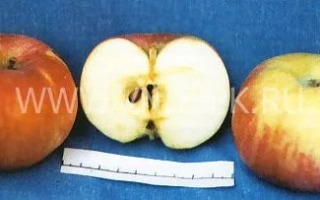
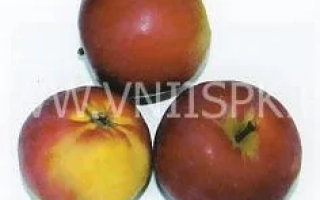
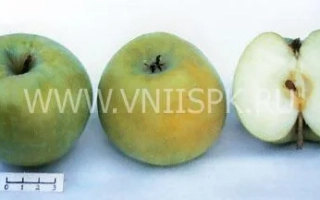
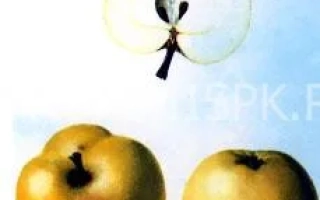
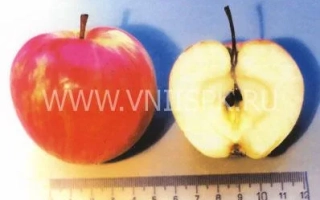
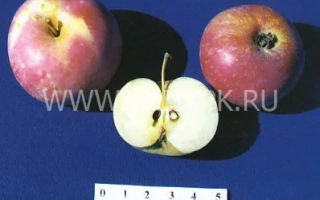
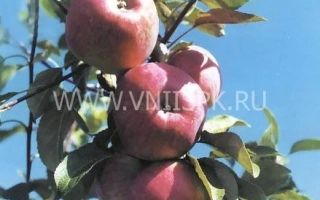
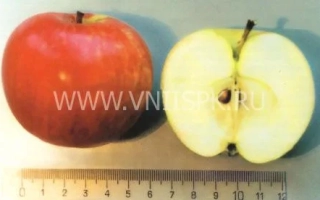
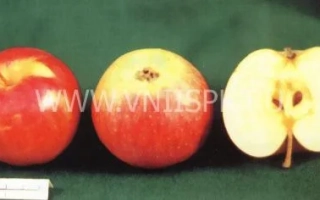
Fruits (see photo) are small (55-90 g), round, symmetrical. Main color is dark cream with slight orange tinge; surface pattern is intense dark red stripes and bands. Peduncle is medium length and thin. Calyx is wide, without rust. Receptacle is small, closed, above a narrow conical base. Seed chambers are closed, with well-developed seeds. Central cavity is small.
Flesh is yellowish, juicy, slightly acidic-sweet, medium density, with mild aroma, good flavor. Chemical composition of fruits: total sugar content — 13.8% (8.7–15.1), titratable acids — 0.90% (0.64–1.12), tannins — 133 mg/100g (71–257), ascorbic acid — 19 mg/100g (14.0–50.0), P-active substances — 315 mg/100g (71–360), pectin substances — 6.15% on dry weight.
Ripening is late-season; fruits can be stored for up to 60 days in storage. Universally useful variety, valuable for gardens of all ownership forms.
Fruit-bearing begins at 4–5 years. Yields are moderate and regular. Trees have high winter hardiness. The variety is highly resistant to scab.
Advantages of the variety: high ecological resistance, regular fruiting.
Disadvantages of the variety: fruit drop and short storage life.
Used in breeding for creating highly adaptable apple varieties. With the participation of this variety, elite forms of 'Altai Blue' have been developed.