


SKU #3265
·
247 views
Altai Winter
Apple
User rating
0 votes0% positive reviews
No ratings yet — be the first.
Type of Sort
Winter Apple Variety
Tree; Growth Power
Medium-height
Tree; Canopy Shape
Round Canopy
Fruit; Fruit Shape
Flat-round
Store offers · 8 from 3 stores
Prices are updated on loadLoading offers…
Available at: Исида Парк · Sadovnik-sam · Интернет магазин садовых растений Все Сорта
Aggregator catalog: prices are collected automatically from store websites, normalized by AI and converted at the current exchange rate. Before ordering, confirm the price and availability on the store's website. This block is not indexed by search engines — the data is loaded after the page opens.
About product

This winter variety was obtained at the Scientific Research Institute of Horticulture of Siberia named after M. A. Lisavensky by crossing the early variety Lalitino with Welsh in 1961. Breeders: I. P. Kalinina, T. F. Kornienko, Z. A. Granikina, E. S. Orekhova. Accepted for State Testing in 1998. Included in the State Register for the West Siberian region. Promising for all types of ownership, esp…
Type of Sort
Winter Apple Variety
Tree; Growth Power
Medium-height
Tree; Canopy Shape
Round Canopy
Fruit; Fruit Shape
Flat-round
Description
This winter variety was obtained at the Scientific Research Institute of Horticulture of Siberia named after M. A. Lisavensky by crossing the early variety Lalitino with Welsh in 1961. Breeders: I. P. Kalinina, T. F. Kornienko, Z. A. Granikina, E. S. Orekhova. Accepted for State Testing in 1998. Included in the State Register for the West Siberian region. Promising for all types of ownership, especially for home gardens, due to its long fruit consumption period, relatively large fruits for Siberian conditions, and good taste.
Trees are medium-sized with a medium-dense, rounded crown. Main branches depart from the trunk at an angle close to straight, branches are straight and directed upwards.
Shoots are medium-sized, slightly curved, greenish-brown, with a large number of stipules. Leaves are medium-sized, round, short-pointed, dark green, matte. Leaf blade is concave, curved upwards, hairy on the underside. Leaf margin is finely toothed. Petiole is short and hairy.
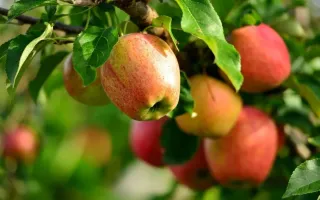
Fruits (see illustration) are medium-sized (70-95 g), flat-round or round, ribbed, with a smooth surface. Main color is greenish-yellow, covering color is dark red, blurred with dark stripes, mostly covering the fruit. Skin spots are small and clearly visible. Pedicel is medium-sized and thin. Calyx is deep and wide, without rust. Receptacle is large, deep, ribbed. Calyx tube is long and funnel-shaped. Seed chambers are closed. Central cavity is narrow.
Flesh is creamy, firm, juicy, finely-grained, slightly tart-sweet, with good flavor. Chemical composition of the fruit: total sugars — 12.2%, titratable acids — 0.96%, pectin substances — 3.14% (1.13-3.40) per dry weight, ascorbic acid — 6.5 mg/100g (5.28-8.6), P-active compounds — 148 mg/100g (87-267).
Fruits ripen in the second decade of September and can be stored up to 150 days. This is a universal variety with a long fruit consumption period.
Fruit production begins in the fourth to fifth year. Yield is medium and regular. Winter hardiness is medium; in exceptionally severe winters, multi-year wood and fruiting structures are moderately frozen. Recovery ability is good. Highly resistant to scab.
Advantages of the variety: relatively large fruits for Siberian conditions, good taste, long consumption period, high resistance to scab.
Disadvantages of the variety: moderately frozen in exceptionally severe winters.
Video · 6 videos
Suggest a video →Crop & resistance
Crop
Disease resistance
Specifications hover over for a hint about the specification
| Type of Sort | |
|---|---|
| Tree; Growth Power | |
| Tree; Canopy Shape | |
| Fruit; Fruit Shape | |
|
Fruit; flesh color
Fruit; flesh color
Color of the fruit flesh. There are red, pink, yellow, and brown colors. |
|
| Fruit; Fruit Color (Base Color) | |
| Fruit; Blush (Blush Color) | |
| Fruit; Fruit mass | 70-95 |
| Fruit; Lying | 5 |
| Cold Resistance | |
| Catalog | Catalog → Apple |
Not yet комментариев. Be the first!
Alternatives
Apple saplings · similar varieties




See also
Often considered together with this variety


Recently viewed
Products you’ve viewed on this site
Reviews · 0