Second-generation seedling of the Primorsky variety. Obtained in a dacha garden in the Republic of Khakasia in 1981. Author I.L. Baykalov. Included in the State Register in 2002. Recommended for the Eastern Siberian region.
Medium-sized trees with an open crown. Young shoots are large, dark red, shiny. Flowering buds of medium size are formed on bouquet branches and on non-woody one-year shoots. By this feature, it fruits annually. Differentiation of flowering buds formed on bouquet branches begins as early as late autumn and proceeds rapidly. After prolonged winter thaws, flowering buds freeze. Leaves are medium-sized, slightly convex at the base, with an elongated apex, dark green in color, leaf margins with blunt teeth. Petiole and central vein are colored red. Flowers are large. Flowering begins on May 11-13. Self-fertility is low. Good pollinators include Eastern Sayan, Northern Glow, etc.
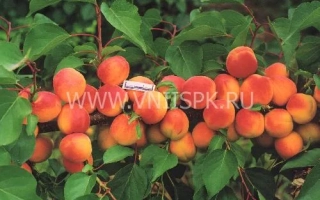
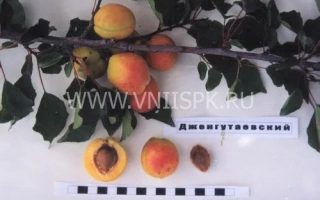
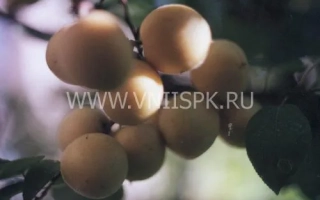
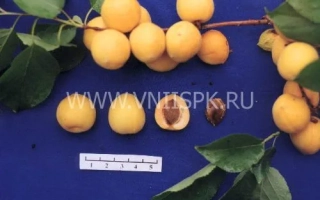
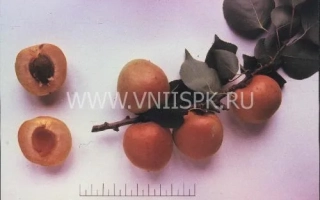
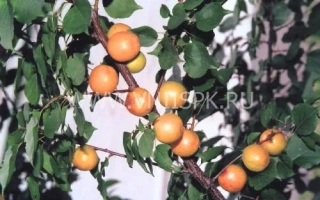
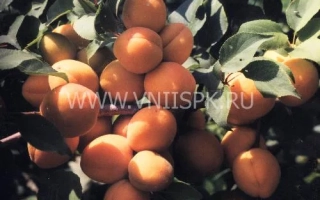
Fruits are large (35 g) and very large (up to 70 g), round in shape, yellow-green in color, with blush on half the fruit and a well-defined seam. Stone is free, kernel is sweet. Flesh is orange, very tasty. Fruits contain 15.5% soluble dry matter, 10% sugars, 2% acids, 0.56% pectin, 7.9 mg/100g vitamin C.
Ripening is very early, second to third decade of July. Begins bearing fruit at 2-3 years. Average yield is 14-17 kg, maximum — 37 kg.
Cold resistance is slightly lower than that of Siberian Baykalov, but trees winter well on elevated sites and in forest-steppe zones. Root neck heaving occurs in snowy and warm winters in the subtaiga zone, and in steppe regions without damage. Dormant period is short.
Morphologically close to the common apricot.
Advantages of the variety: large, tasty fruits with early ripening.
Disadvantages: susceptible to rot, freezes in harsh winters.