


SKU #4072
·
372 views
Samarsky
Apricot
User rating
0 votes0% positive reviews
No ratings yet — be the first.
Assignment
Universal
Flavor
Sour-sweet
Core
Easily removable
Fruit Color
Yellow
Store offers · 2 from 2 stores
Prices are updated on loadLoading offers…
Available at: Лучший Сад · Царь Сад
Aggregator catalog: prices are collected automatically from store websites, normalized by AI and converted at the current exchange rate. Before ordering, confirm the price and availability on the store's website. This block is not indexed by search engines — the data is loaded after the page opens.
About product

Introduced by A.N. Minin at the Samara Regional Experimental Station for Horticulture as a result of crossing the 'Kuybyshevskiy Yubileyniy' and 'Kuybyshevskiy Ranniy' varieties. Registered in the State Register for the Middle Volga region in 2005. Medium-sized tree, medium-growing. Open, medium-density crown. Bears fruit primarily on spurs and bouquet branches. Bark on the trunk and main branche…
Assignment
Universal
Flavor
Sour-sweet
Core
Easily removable
Fruit Color
Yellow
Description
Introduced by A.N. Minin at the Samara Regional Experimental Station for Horticulture as a result of crossing the 'Kuybyshevskiy Yubileyniy' and 'Kuybyshevskiy Ranniy' varieties. Registered in the State Register for the Middle Volga region in 2005.
Medium-sized tree, medium-growing. Open, medium-density crown. Bears fruit primarily on spurs and bouquet branches. Bark on the trunk and main branches is smooth and gray. Shoots are medium, straight, reddish-brown, bare. Buds: few, medium, white. Leaves are medium, egg-shaped, long-pointed, dark green, smooth. Leaf blade: concave (like a boat) upward, apex gradually pointed, base rounded, no pubescence. Leaf margin finely toothed. Stipules absent. Petiole medium in length and thickness, pigmented. Stamen: medium, two, yellow. Inflorescence — double, solitary flowers. Flowers are rose-like, large, white.
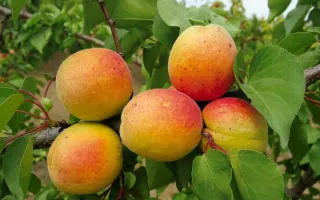
Fruits are medium, one-dimensional, average weight 17.6 g, egg-shaped. Fruit apex slightly elongated, pit narrow and small. Fruit base with indentation, pit small. Ventral suture of medium depth, distinct. Pedicel short, medium thickness, easy detachment from branch, weak attachment to stone. Fruit color yellow, solid. No lenticels. Skin medium, tender, slightly pubescent. Flesh yellow, juicy, firm. Juice colorless. Flavor sour-sweet. Stone separates easily from flesh, medium, egg-shaped, smooth. Fruit flavor — 4.4 points. Appearance — 4.4 points. Fruits contain 13.1% dry matter, 8.42% sugars, 2.40% acids, 13.8 mg vitamin C per 100g. Fruit use is universal.
Harvesting period — August 7-12. Fruit quality for market and consumer use is high. Under-ripe fruits store for 7-10 days. Fruit transportability is high.
Flowering — May 1-3. Fruit maturity is late. Partially self-fertile. Best pollinators: 'Kuybyshevskiy Yubileyniy', 'Karakul'. Enters fruiting at 4 years and quickly increases yields. Yield at age 8 years — 15-20 kg per tree, at age 12-13 — 40-50 kg. Annual fruiting. Fruits remain firmly on the tree, do not drop even when overripe.
Cold-resistant variety. High wood and flower bud cold resistance. Flowers and ovaries are resistant to spring frosts. In 2000, during flowering, flower buds were damaged by frosts down to -3°C, affecting 10%. According to 2002 data, under -7°C frosts affecting ovaries in mid-May, yield was 56 kg per tree.
Drought-tolerant. Resistant to bark canker. Affected by moniliosis up to 0.5%. Affected by fruit worm up to 0.2%.
Propagated by grafting onto seedling rootstocks of cold-resistant varieties: 'Krasnaya Skorospelka', 'Kuybyshevskaya Ternoslyvka', 'Oktabrskaya Vengerka', and clonal rootstock OPА-15-2.
Trees grow well on elevated western, southwest, and northwest slopes, on light and medium-textured soils.
Young trees require formative pruning. During full fruiting, prune ends of new growth by one-third, in older trees perform rejuvenating pruning.
Advantages of the variety: high wood and flower bud cold resistance, high annual yield, high-quality fruit.
Disadvantages of the variety: not sufficiently large fruits.
Crop & resistance
Crop
Disease resistance
Specifications hover over for a hint about the specification
| Assignment | |
|---|---|
| Flavor | |
| Core | |
|
Fruit Color
Fruit Color
The fruit color of tomato varieties is influenced by the combination of skin and flesh color. Some varieties have transparent skin, others — yellow. When combined differently, the fruits can acquire quite diverse colors. The fruit color is affected by pigments (lycopene) and thei... |
|
|
Yield
Yield
Overall bulb harvest per unit area. Depends on both onion variety characteristics and agronomic practices, fertilizers, and irrigation. Under optimal growing conditions, an onion yield of 100 tons per hectare and above is not considered record-breaking. |
15-50 |
| Self-fertility | |
| Disease Resistance | |
| Transportability | |
| Zoning | |
| Features | |
| Catalog | Catalog → Apricot |
Not yet комментариев. Be the first!
Alternatives
Apricot saplings · similar varieties





See also
Often considered together with this variety


Recently viewed
Products you’ve viewed on this site
Reviews · 0