

Description
Symptoms
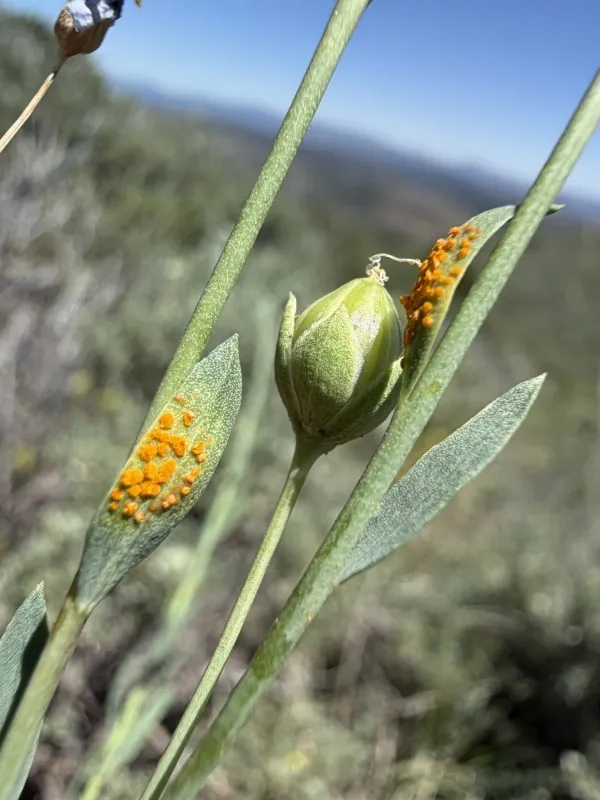
The first symptoms in spring appear as bright orange-yellow pustules called aecia on cotyledons and leaves. These pustules represent ruptures in the plant epidermis as the fungus emerges.
As the season progresses, vivid orange uredinia develop on leaves, stems, and seed capsules. These structures contain massed urediniospores, which appear as a powdery rust-colored dust that disperses easily upon contact.
Toward the end of the growing season, as the flax matures, the orange spots transition to dark brown or black. This stage represents the development of telia, where the fungus prepares to overwinter on crop remains.
Severe infection leads to premature leaf drying and abscission, which significantly impairs the plant's photosynthetic capacity. Stems become brittle and lose their structural integrity, negatively affecting fiber quality.
When capsules are infected, the seeds formed are often shriveled, underdeveloped, and possess poor germination rates, resulting in significant yield loss for both fiber and oil production.
Pathogen
Flax rust is caused by the fungus Melampsora lini, a highly specialized obligate pathogen classified within the Basidiomycota phylum. It completes its entire life cycle on flax plants, making it a persistent threat to commercial production.
The fungal life cycle involves multiple stages, including the production of aeciospores, urediniospores, and teliospores. The disease spreads rapidly during the growing season primarily through airborne urediniospores, which can travel long distances.
The fungus overwinters as teliospores on crop debris, stubble, or within contaminated seeds if they are not properly processed. In spring, these spores germinate to infect young seedlings, initiating a new epidemic cycle.
Due to the pathogen's narrow host specificity, different races of Melampsora lini target specific flax varieties. This necessitates continuous breeding efforts to develop cultivars resistant to local fungal populations.
The pathogen's mycelium grows primarily within the intercellular spaces of plant tissues, using specialized structures called haustoria to extract nutrients, which gradually weakens the host plant.
Conditions for development
Flax rust development is favored by moderately warm weather and high humidity. Optimal temperatures for spore germination typically range from 15 to 22 degrees Celsius.
Frequent rainfall or heavy morning dew during the first half of the growing season creates ideal conditions for the spread of urediniospores. Moisture films on plant surfaces are essential for successful spore germination and tissue penetration.
Dense flax stands with poor air circulation are significantly more prone to widespread outbreaks. Excessive nitrogen fertilization, which encourages lush, succulent growth, also increases the host's susceptibility to infection.
The presence of crop residue from previous seasons provides a primary source of inoculum, serving as a reservoir for the fungus to jump onto young, emerging crops in the spring.
Stable weather patterns featuring alternating periods of humidity and sunshine accelerate the generation time of the pathogen, potentially leading to rapid epidemic development across large agricultural fields.
Why it matters
The primary economic impact of flax rust is the significant reduction in fiber quality. Infected stems become brittle and weak, leading to a substantial decrease in the marketable grade of the harvest.
The disease causes a major reduction in seed yield. The seeds become small and possess lower oil content, making the harvest unsuitable for high-quality planting stock or commercial processing.
By diverting nutrients from the host plant to the fungus, the infection stunts the plant's overall growth and development. The plant allocates vital energy to fight the pathogen rather than developing productive organs.
Early-season infections can lead to the death of young seedlings, resulting in thin, patchy stands. This poor density encourages weed growth, which further competes with the flax and lowers overall field productivity.
Economic losses are compounded by the high costs of fungicide applications and the devaluation of the final crop due to reduced yield and lower industrial utility of the damaged fibers.
Protection
The most effective strategy for managing flax rust is the use of locally adapted varieties that possess genetic resistance to prevailing races of the fungus. Resistant cultivars remain the foundation of sustainable crop protection.
Strict adherence to crop rotation is essential; flax should not be replanted in the same field for at least 6–7 years. This allows the soil-borne inoculum to decline to negligible levels through natural decomposition.
Deep plowing in the autumn to bury infected crop residues is critical. This accelerates the decomposition of debris and destroys the fungal structures, such as telia, that survive the winter on stubble.
If initial symptoms are detected, the timely application of systemic fungicides, particularly those containing triazoles or strobilurins, can effectively suppress the further spread of the rust during the growing season.
Maintaining spatial isolation between new flax fields and previous year's planting sites, along with rigorous weed management to remove alternative hosts, helps significantly in lowering the risk of disease outbreaks.
Content graph
Connections · Flax rust
Most often together:
Marketplace
Products · 77





Community
Discussion
No discussions yet — be the first.