

Description
How to identify
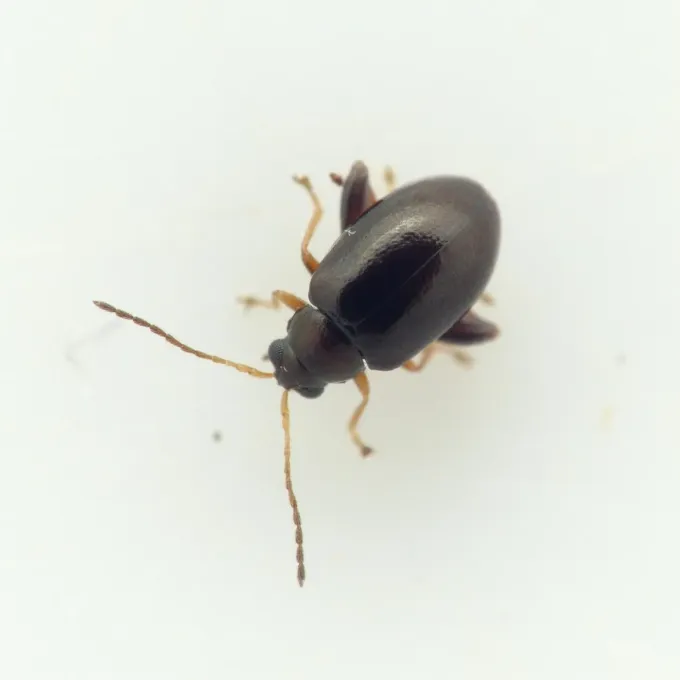
The flax flea beetle (Longitarsus parvulus) is a small beetle belonging to the Chrysomelidae family. Adults are approximately 1.5–2 mm long, typically characterized by a bronze-black or dark metallic body, which distinguishes them from other flea beetle species.
Like all flea beetles, this insect possesses enlarged hind legs adapted for jumping. When disturbed, the beetles jump rapidly, making them difficult to catch or observe closely without specialized monitoring techniques.
The larvae are small, worm-like, and white in color, measuring about 3–4 mm in length. They develop below the soil surface, primarily feeding on root tissues and root hairs, which makes them less visible than the adult beetles that feed on foliage.
The life cycle consists of four distinct stages: egg, larva, pupa, and adult. They typically overwinter as adults in soil crevices, leaf litter, or nearby vegetation, emerging in early spring when temperatures rise sufficiently.
Identification is easiest in warm, sunny weather, when adults are most active on the leaves of young flax seedlings, creating the characteristic "shot-hole" damage that is highly indicative of their presence.
What it damages
The flax flea beetle is a specialized pest primarily targeting flax (Linum usitatissimum). It poses a major threat during the seedling stage, when the plants are most tender and have little ability to recover from damage.
Adult beetles feed on the cotyledons and the first true leaves, chewing numerous small holes in the leaf tissue. This reduces the photosynthetic capacity of the plant and can lead to the total destruction of young seedlings if beetle density is high.
Larval feeding on the roots causes internal damage that impairs the plant's nutrient and water uptake. This contributes to the overall weakening of the flax crop, making it more susceptible to environmental stress and secondary infections.
Severe infestations often result in stunted growth, yellowing of the seedlings, and eventual death, leading to significant stand losses that may necessitate reseeding of the field.
Damage intensity is highly dependent on climate conditions. Hot and dry springs favor the beetle's feeding activity and rapid reproduction, potentially causing devastating yield losses in both fiber and seed flax production.
When it appears
The activity season begins in mid-spring, typically May, as soil temperatures reach 8–10°C. This is when overwintering adults emerge from their dormant state to seek out suitable host plants.
The most critical period for crop protection is the time from seedling emergence to the appearance of the 3rd or 4th pair of true leaves. This is when the flax plant is most vulnerable to the adult beetles' rapid defoliation.
Larval development occurs throughout late spring and early summer within the soil. While adult activity declines as the season progresses, the cumulative impact of both stages determines the final health and density of the flax stand.
The new generation of adults usually emerges in mid-summer. These beetles may feed on surviving foliage or weed hosts before entering hibernation to survive the winter months, completing the annual cycle.
Regular scouting throughout the emergence window is essential for successful management. Farmers must be prepared to intervene as soon as the first signs of damage appear, as populations can explode quickly under optimal weather conditions.
Signs of infestation
The most recognizable sign is the "shot-hole" appearance on cotyledons and young leaves. The leaf surface looks perforated, which is a clear diagnostic feature of flea beetle feeding activity.
Observation of the field on a sunny day will reveal small, dark insects jumping upon disturbance. A simple sweep with a hand over the crop can trigger a mass jump, indicating the presence and density of the pest.
Stunted development and general wilting of the seedlings are secondary signs, often indicating either heavy adult feeding or damage to the root system caused by the larvae.
Thinning of the stand is a major sign of high infestation levels. When plants fail to emerge or collapse shortly after, it is often due to the beetles consuming the plant tissue near the base or destroying the root system.
The presence of necrotic spots or secondary fungal infections on the damaged leaves serves as a final indicator that the plant has been significantly stressed by insect feeding, potentially leading to plant failure.
Control measures
Strategic crop rotation is the foundation of management. Avoiding the planting of flax on the same ground for at least 5 years helps break the life cycle of the beetle and prevents population buildup.
Cultural practices, such as early seeding and ensuring a proper, uniform sowing depth, allow the plants to develop quickly through the most sensitive growth stages, minimizing the time they remain attractive to beetles.
Seed treatment with systemic insecticides is the most effective and widely used preventive measure. It provides long-lasting protection to the seedlings during the critical early weeks of growth.
If economic thresholds are exceeded, foliar insecticide applications are required. Products from different chemical classes should be used in rotation to avoid the development of insecticide resistance in beetle populations.
Maintaining optimal soil fertility, particularly with balanced phosphorus and potassium levels, promotes strong root growth, enabling the flax plants to withstand minor flea beetle damage and recover more efficiently.
Content graph
Connections · Flax flea beetle
Most often together:
Marketplace
Products · 1
Biology
Taxonomy
- Latin name
- Longitarsus parvulus
- Order
- Coleoptera (beetles)
- Family
- Chrysomelidae
- EPPO code
- LONIPA
Community
Discussion
No discussions yet — be the first.