


SKU #68110
·
56 views
ERUSLAN
Flax
RosNIIPITI SK / Saratovskiy GUBIUser rating
0 votes0% positive reviews
No ratings yet — be the first.
Type of Flax
Olive
Ripening Period
85-100
Oil Content
40-44
Potential Yield
1.5-2.5
About product

The Eruslan variety of oil flax is a mid-ripe oil flax with a growing period ranging from 79 to 104 days, depending on the cultivation region. This variety is characterized by a medium stem length, white corolla color in the bud stage and at full development, as well as yellow seeds with a medium mass of 1000 seeds at 6.8 grams. The seed pod is of medium size, with a fringed false partition, and t…
Type of Flax
Olive
Ripening Period
85-100
Oil Content
40-44
Potential Yield
1.5-2.5
Description
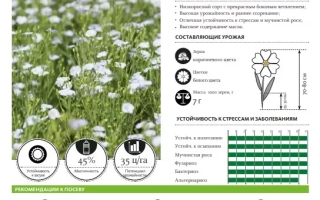
The Eruslan variety of oil flax is a mid-ripe oil flax with a growing period ranging from 79 to 104 days, depending on the cultivation region. This variety is characterized by a medium stem length, white corolla color in the bud stage and at full development, as well as yellow seeds with a medium mass of 1000 seeds at 6.8 grams. The seed pod is of medium size, with a fringed false partition, and the stigma at the base has a blue tint. Eruslan boasts high yields, reaching an average of 16-17.4 centners per hectare in various regions, making it attractive for agricultural production. One of the key advantages of the variety is the high fat content in the seeds, varying from 41.2% to 46.5%, with a high level of linoleic acid (22.6-28.8%), ensuring the oil's value for food use. The oil obtained from Eruslan seeds is distinguished by quality characteristics and can be used in the food industry. Additionally, the variety demonstrates disease resistance; during years of testing, no disease infestations were recorded, which enhances the reliability and stability of the yield. Eruslan is recommended for cultivation in various regions, including the Middle Volga, Ural, as well as northern and Central Asian areas, such as North Kazakhstan, Kostanai, Almaty, and Karaganda. Thanks to its adaptability to climatic conditions and disease resistance, this oil flax variety is a profitable choice for farmers seeking high-quality raw materials with high yields and valuable oil.
Crop & resistance
Crop
Disease resistance
Specifications hover over for a hint about the specification
| Type of Flax | |
|---|---|
|
Ripening Period
Ripening Period
It takes 70-100 days until pepper reaches flowering stage, 130-160 days until technical fruit ripeness, and 135-180 days until physiological ripeness. |
85-100 |
| Oil Content | 40-44 |
| Potential Yield | 1.5-2.5 |
| Flower Color | |
| Assignment | |
| Registration year | 2017 |
| Catalog | Catalog → Flax |
| Manufacturer | RosNIIPITI SK / Saratovskiy GUBI |
| Legal data |
Show · 14
|
| Country | Russia |
Store offers
Prices are updated on loadLoading offers…
Aggregator catalog: prices are collected automatically from store websites, normalized by AI and converted at the current exchange rate. Before ordering, confirm the price and availability on the store's website. This block is not indexed by search engines — the data is loaded after the page opens.
Not yet комментариев. Be the first!
Alternatives
Flax seeds · similar varieties




See also
Often considered together with this variety


Recently viewed
Products you’ve viewed on this site
Reviews · 0