
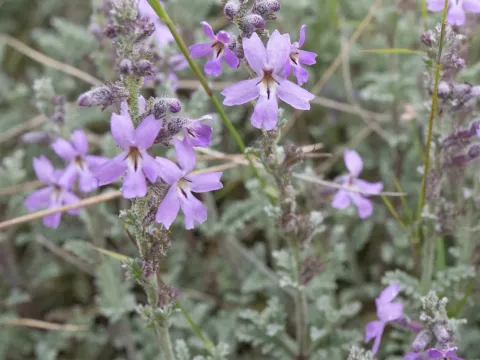
Jamesbrittenia
Jamesbrittenia O. Kuntze
Jamesbrittenia is a genus of flowering plants belonging to the Scrophulariaceae family, originating primarily from the arid and semi-arid regions of Southern Africa. These plants are prized in horticulture for their resilient nature and decorative flowers that bloom profusely throughout the growing season.
What the section contains
 Jamesbrittenia
 breviflora (Schltr.) Hilliard x J. grandiflora (Galpin) Hilliard
Jamesbrittenia
Jamesbrittenia breviflora (Schltr.) Hilliard x J. grandiflora (Galpin) Hilliard
 Jamesbrittenia bergae
 Lemmer
Jamesbrittenia bergae
Jamesbrittenia bergae Lemmer
 Jamesbrittenia breviflora
 (Schltr.) Hilliard
Jamesbrittenia carvalhoi
Jamesbrittenia carvalhoi (Engl.) Hilliard
Jamesbrittenia breviflora
Jamesbrittenia breviflora (Schltr.) Hilliard
Jamesbrittenia carvalhoi
Jamesbrittenia carvalhoi (Engl.) Hilliard
 Jamesbrittenia grandiflora
 (Galpin) Hilliard
Jamesbrittenia grandiflora
Jamesbrittenia grandiflora (Galpin) Hilliard
Jamesbrittenia
Botanically, they exhibit diverse forms, ranging from herbaceous annuals to small, spreading subshrubs. Their foliage is typically small and serrated, while the flowers display a diverse palette including shades of white, pink, purple, and yellow, often featuring a distinct star-like shape.
In terms of climate, Jamesbrittenia requires full sun exposure and warm temperatures to thrive. As a tender perennial, it is sensitive to frost, which is why it is widely cultivated as a container plant or annual bedding plant in cooler climates where winter survival outdoors is impossible.
The agricultural requirements for this crop focus on providing excellent soil drainage. The growing medium should be porous and slightly acidic to neutral to prevent waterlogging, which is a common cause of failure in cultivating these South African native species.
They are extensively used in landscaping, particularly in hanging baskets, balcony boxes, and as ground covers in rock gardens. Their ability to cascade over the edges of containers makes them a preferred choice for ornamental vertical displays.
The primary threats to Jamesbrittenia include fungal infections such as root rot, which are triggered by over-irrigation or inadequate soil drainage. Maintaining a moderate moisture level is critical to the plant's long-term health.
Common pests that affect the crop include spider mites, whiteflies, and aphids, particularly in greenhouse or indoor environments where air circulation may be restricted and temperatures remain consistently high.
Effective management of diseases requires periodic application of fungicides and ensuring adequate airflow to reduce humidity levels around the foliage, which helps prevent mildew development.
For pest control, integrated pest management strategies are recommended, including the use of targeted systemic insecticides and the physical removal of heavily infested plant parts.
Proactive care involves monitoring for symptoms of stress or pest presence, ensuring the plant receives optimal light, and using balanced liquid fertilizers to sustain vigorous growth throughout the flowering period.