
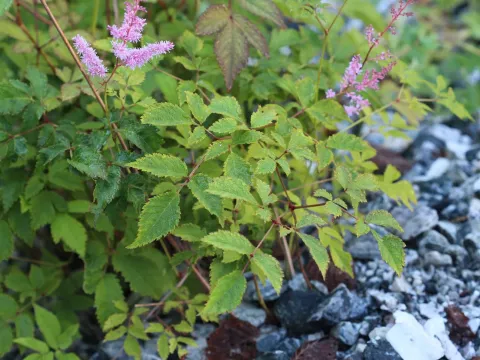
Astilbe
Astilbe Buch.-Ham. ex D. Don
Astilbe (Astilbe Buch.-Ham. ex D. Don) is a genus of perennial herbaceous plants belonging to the Saxifragaceae family. These plants are native to the mountain ravines and woodland habitats of East Asia and North America, thriving in regions with high humidity.
What the section contains
 Arends Astilbe
Astilbe x arendsii H. Junge
Arends Astilbe
Astilbe x arendsii H. Junge
 Astilbe crispa
Astilbe x crispa (Arends) Bergmans
Astilbe crispa
Astilbe x crispa (Arends) Bergmans
 Astilbe simplicifolia
 Makino
Astilbe simplicifolia
Astilbe simplicifolia Makino
 Astilbe thunbergii
 (Siebold & Zucc.) Miq.
Astilbe thunbergii
Astilbe thunbergii (Siebold & Zucc.) Miq.
 Chinese astilbe
Astilbe chinensis (Maxim.) Franch. & Sav.
Crisped Astilbe
Astilbe xcrispa x Astilbe japonica
Chinese astilbe
Astilbe chinensis (Maxim.) Franch. & Sav.
Crisped Astilbe
Astilbe xcrispa x Astilbe japonica
 Hybrid Astilbe
Hybrid between Astilbe x arendsii and Astilbe japonica
Japanese astilbe
Astilbe japonica (C. Morren & Decne.) A. Gray
Hybrid Astilbe
Hybrid between Astilbe x arendsii and Astilbe japonica
Japanese astilbe
Astilbe japonica (C. Morren & Decne.) A. Gray
Astilbe
The plant is distinguished by its compound, fern-like foliage and plumy, feathery flower panicles that bloom in a range of colors including pink, red, white, and purple. The botanical structure is designed to persist through harsh winters with a robust underground rhizome.
To cultivate astilbe successfully, one must provide a location with partial to full shade. These plants are highly susceptible to leaf scorch if exposed to intense direct sunlight for extended periods, especially during hot summer months.
The soil requirements are strict: the plants need rich, humus-dense, and consistently moist soil. Unlike many other perennials, astilbe requires a steady supply of water to sustain its lush foliage, making it an ideal choice for rain gardens or near pond edges.
Agrotechnical practices involve regular fertilization with organic compost in the early spring to promote vigorous growth. Additionally, applying a layer of organic mulch around the base of the plant is recommended to maintain soil moisture and suppress weed development.
Common pests affecting astilbe populations include the tarnished plant bug and various species of nematodes. These insects often target the buds and leaves, causing stunted growth and poor flower quality.
Regarding diseases, powdery mildew and bacterial leaf spot are the most prevalent threats, typically occurring in conditions with poor air circulation. Proper spacing between plants and regular sanitation help to minimize the risk of infection.