
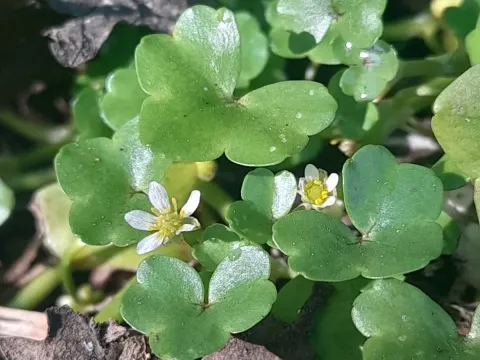
Ivy-leaved crowfoot
Ranunculus hederaceus
Ivy-leaved crowfoot (Ranunculus hederaceus) is a perennial herbaceous plant belonging to the Ranunculaceae family. This species is specifically adapted to wet environments and is commonly found in semi-aquatic habitats.
What the section contains
Ivy-leaved crowfoot
The plant is native to Western and Southern Europe, where it thrives in temperate climatic zones. It is typically found in shallow waters, muddy banks of streams, and damp depressions where the soil remains saturated.
Botanically, it is characterized by creeping stems that root at the nodes. The leaves are typically rounded or kidney-shaped with shallow lobes, which gives the plant its distinctive appearance and common name.
Regarding soil and moisture requirements, it prefers nutrient-rich or silty mud. Consistent moisture is the most critical factor for its survival, as it does not tolerate prolonged drought or complete drying out of the habitat.
Sunlight exposure should be moderate. While it can survive in partial shade, it requires sufficient light to maintain healthy growth and flower production during the active growing season.
The primary threats to this species are land drainage and changes in hydrological regimes, which lead to the loss of its natural wetland habitats.
Fungal pathogens often pose a risk when the water quality becomes stagnant or poorly oxygenated, leading to stem rot and damage to the root system.
Competition from invasive plant species is a major issue, as faster-growing aquatic plants can quickly overshadow the ivy-leaved crowfoot, limiting its access to light.
Pests, although less frequent than in terrestrial crops, include aquatic larvae that may feed on the soft succulent tissues of the stems and leaves.
Conservation efforts must focus on maintaining the integrity of wetland ecosystems and ensuring that local water bodies are free from excessive nutrient runoff.