
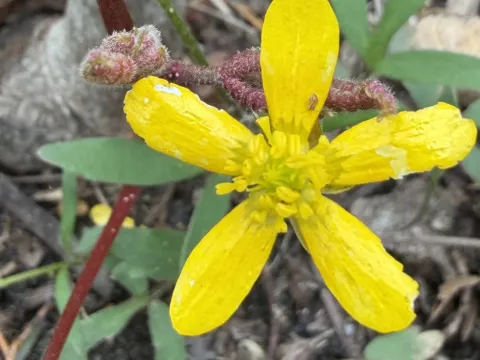
Early buttercup
Ranunculus fascicularis
The Early buttercup (Ranunculus fascicularis) is a perennial herbaceous plant belonging to the Ranunculaceae family. It is native to North America, where it typically inhabits open woodlands, rocky slopes, and prairie ecosystems, thriving in diverse environmental conditions.
What the section contains
Early buttercup
One of the most distinct botanical features of this species is its root system, which consists of thickened, fascicled (bundled) roots. This adaptation allows the plant to store energy and survive periods of limited rainfall, which is a critical strategy for a spring ephemeral.
The plant grows best in well-drained soils and shows a preference for sunny sites where it can complete its life cycle before deciduous trees develop a full canopy. It is highly valued for its early spring blooms, which provide a vital food source for early-season pollinators.
Morphologically, the Early buttercup is characterized by a rosette of deeply lobed leaves and bright yellow flowers on stalks reaching 10 to 30 centimeters in height. Its life cycle is tightly synchronized with the brief window of optimal spring moisture and light.
In terms of agricultural utility, it is generally considered a wild component of the pasture flora rather than a managed crop. Due to the presence of mild toxins common to the Ranunculus genus, it is typically avoided by livestock, which helps preserve its population in grazed areas.
The primary threat to the Early buttercup is the destruction of its natural habitat through land development and intensive farming practices. The conversion of native prairies to monoculture fields leads to a drastic reduction in available sites for this species.
Disease pressure, such as powdery mildew, can affect the plant during unseasonably humid springs, potentially reducing the vigor of the colony. While not usually fatal to established plants, such infections can limit reproductive success by reducing seed production.
Insect pests including leaf miners and aphids can cause localized damage to the foliage. While these insects usually do not cause total plant failure, they can weaken the plant's ability to store sufficient carbohydrates in its roots for the following year.
Invasive species represent a major competitive threat to the Early buttercup. Aggressive non-native grasses can easily outcompete this low-growing ephemeral, blocking essential sunlight during the plant's short window of active growth and development.
Chemical control measures, specifically the application of broad-spectrum herbicides in agricultural and roadside management, pose a significant risk to the plant. Because the species is highly sensitive to common herbicides, it is frequently eliminated from areas under intensive chemical management.