
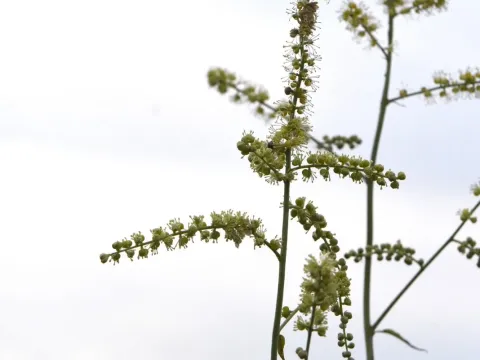
Black cohosh
Actaea cimicifuga
Sowing seeds of black cohosh is primarily performed in autumn directly into the open ground, as the seeds require a long period of cold stratification to germinate. In professional farming or nursery conditions, a seedling method is often used, involving cold treatment of seeds in climate-controlled chambers.
What the section contains
Black cohosh
The optimal sowing time is October or November, ensuring that the seeds undergo a natural cooling cycle before spring temperatures rise. Seeds should be planted at a shallow depth of about 1–2 centimeters, as deeper planting may prevent emergence due to their small size.
Spring sowing without prior stratification leads to poor germination rates. Therefore, agronomists recommend sowing in containers filled with loose substrate and placing them outdoors under snow to mimic natural conditions for the required dormancy period.
The development of seedlings is notably slow in the first year, as the plant focuses its energy on establishing a root system and a basal rosette of leaves. Full flowering and peak biomass development typically occur only in the third or fourth year of growth.
The site selection must account for the mature size of the plant, which can exceed 1.5 meters in height. Row spacing of 60–80 centimeters is recommended to ensure adequate air circulation and to facilitate maintenance and harvesting operations.
Black cohosh is a member of the Ranunculaceae family and prefers partially shaded or shaded locations, protected from direct midday sun. Excess light can scorch the foliage and decrease the concentration of active medicinal compounds.
The crop requires consistently moist, fertile, and well-drained loamy soil with a neutral to slightly acidic pH level. Water stagnation is detrimental to the root system and must be avoided through proper site preparation and drainage.
The plant is sensitive to drought and low air humidity, making regular irrigation essential during dry spells. Mulching the root zone with compost or decomposed leaf mold helps maintain soil moisture levels and stable soil acidity.
Naturally found in the forested regions of Eastern Asia and Siberia, the plant is well-adapted to temperate climates. It exhibits excellent winter hardiness and does not require additional protection during the winter months in most temperate zones.
For intensive cultivation, organic fertilizers should be applied in the spring at the start of the vegetative season. Mineral fertilizers high in nitrogen can be used to promote foliage growth, but they should be applied judiciously to prevent weak, succulent tissues.
The primary economic value of black cohosh lies in its rhizomes, which are rich in triterpene glycosides used in pharmaceutical applications. The yield depends heavily on the age of the plantation, which is typically harvested after 5 to 7 years of growth.
Harvesting is carried out in the autumn after the foliage dies back or in early spring before active sap flow begins. These periods are optimal as the concentration of biologically active substances in the roots is at its maximum.
The average yield of dried roots per hectare ranges from 15 to 25 centners, depending on soil fertility and irrigation management. Consistent water supply is the most significant factor influencing final harvest weight.
While the roots are the main commodity, flower spikes are occasionally harvested for the florist industry or for essential oil extraction. However, the commercial focus remains primarily on the production of medicinal root mass.
After harvesting, the roots must be thoroughly washed to remove soil particles and trimmed of damaged parts. Drying should be conducted in controlled environments at temperatures not exceeding 45 degrees Celsius to preserve the chemical integrity of the harvest.
Black cohosh possesses natural resistance to many common agricultural pests due to its strong, specific odor. However, in overly damp conditions, slugs and snails can cause damage to young, tender leaves by feeding on them.
Improper cultivation practices, such as poor drainage or overcrowded planting, can lead to fungal diseases including powdery mildew and root rots. Systemic fungicides and improved air circulation are the primary methods for managing these issues.
Aphids may occasionally infest flower spikes during the budding stage, weakening the plant. Biological control agents are preferred in large-scale farming to ensure that the medicinal raw material remains free from chemical residues.
Autumn waterlogging frequently promotes mold development in the root zone, which can lead to plant death. Maintaining clean fields by controlling weeds is essential, as weeds can act as reservoirs for various pathogens.
Crop rotation is vital for the long-term health of the plantation; the site should not be replanted with black cohosh for at least 5 years. This practice effectively reduces the accumulation of soil-borne pathogens specific to the Ranunculaceae family.