
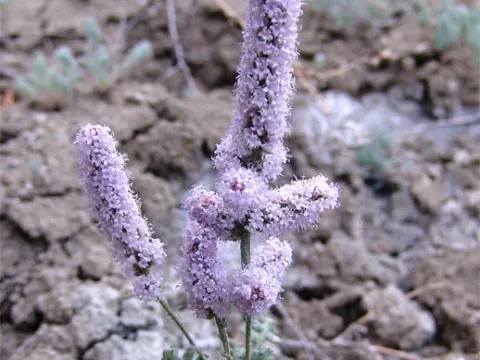
Psylliostachys spicata
Psylliostachys spicata
Psylliostachys spicata is an ephemeral plant, meaning its sowing dates are strictly tied to spring moisture availability. The optimal period for sowing occurs in early spring when snowmelt water is still present in the upper soil layers.
What the section contains
Psylliostachys spicata
In arid regions, seeds are sown immediately after the soil warms up to +8...+10 degrees Celsius. It is crucial to ensure good contact between seeds and moist soil, as the fine seeds of Psylliostachys are highly sensitive to surface drying.
The sowing depth should be minimal, ranging from 0.5 to 1.0 centimeters. If planted deeper, the germination energy drops significantly due to the physiological limitations of the small seeds of this species.
To ensure uniform emergence, rolling the soil after sowing is recommended, as this optimizes moisture distribution and improves capillary water rise to the seeds.
The period from sowing to flowering is only 40–60 days, allowing the crop to complete its lifecycle before the onset of extreme summer heat and severe drought conditions.
Psylliostachys spicata belongs to the Plumbaginaceae family and is a classic halophyte, capable of growing in saline soils, which makes it a valuable candidate for the reclamation of degraded salt flats.
The plant has low soil fertility requirements; however, a high concentration of salts in the soil solution is crucial, as the culture has evolved specifically to adapt to these saline conditions.
The best climatic conditions for development are semi-desert and steppe zones. The crop exhibits high drought tolerance, which is attributed to its ephemeral nature and rapid biomass accumulation.
The plant requires full sun and cannot tolerate shading from other taller species. In agroecosystems, it is important to follow low seeding rates to prevent competition between individual plants for sunlight.
Successful growth of Psylliostachys requires an open landscape with good soil aeration, as water stagnation and excessive soil compaction can lead to root system decay.
The yield of green biomass of Psylliostachys spicata depends directly on the amount of spring precipitation. In favorable years, the plant forms a sufficient amount of vegetative mass for use as pasture forage.
Biological productivity is limited by the short growing season; therefore, the crop is best viewed as an additional early-spring resource for livestock feeding.
When grown on specialized saline plots, the dry matter yield can range from 5 to 12 centners per hectare, depending on the intensity of soil salinity.
Seed collection yields depend heavily on the timing of the harvest. It is important to conduct harvesting within a narrow window to prevent seed shedding, which occurs easily as the spikes mature.
The economic viability of growing this crop is often associated not only with its forage value but also with its ability to improve the physical and chemical properties of saline soils.
Psylliostachys spicata is highly resistant to many common agricultural pests, which is likely due to the presence of specific secondary metabolites in its tissues that deter herbivores.
A significant threat to seedlings comes from soil-dwelling pests, such as wireworms, which can damage the root system during the early stages of development, reducing overall stand density.
Among diseases, fungal infections such as powdery mildew or root rot are the most common, often occurring under conditions of high air and soil humidity in late spring.
A critical risk factor for the crop is weed infestation by more competitive species, which can suppress the development of Psylliostachys in the early phases of growth.
Protection measures include crop rotation and timely mechanical weed control, while chemical pesticide treatments are rarely used due to their low economic efficiency for this species.
Harvesting green biomass for forage is performed during the mass flowering phase, when the plant maximizes nutrient accumulation before the stems lignify and the plant transitions to the reproductive phase.
Seed collection is carried out via direct combining or two-phase harvesting upon reaching full maturity. Due to its high tendency to shed seeds, harvesting should be performed in early morning or evening hours.
After mowing, quick drying is desirable if the material is to be used as hay, although direct grazing on the plots is more commonly practiced due to the small volume of biomass produced.
Harvesting machinery should be adjusted for a low cutting height to capture maximum leaf mass while avoiding the intake of excessive soil and salt particles.
The harvested seeds require immediate cleaning and proper storage, as fine seeds are prone to self-heating if stored with high moisture content.