
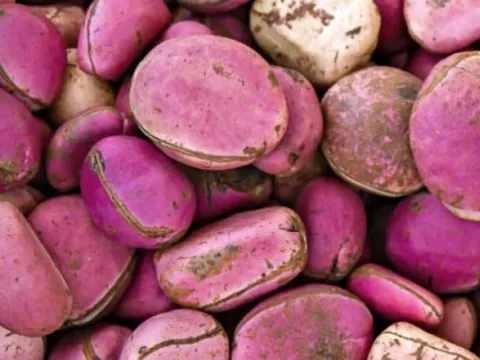
Kola
Cola
Propagation of the kola tree is primarily achieved through seeds, which must be planted soon after extraction from the fruit due to their short viability. Fresh seeds are sown in shaded nursery beds containing a rich, well-draining potting medium to ensure uniform germination.
What the section contains


Kola
The germination process typically takes three to six weeks under warm and humid conditions. Consistent soil moisture is crucial during this phase to prevent the seeds from drying out, as they are sensitive to environmental stress.
Once the seedlings reach a height of 30–50 centimeters, they are ready for transplanting into the field. The best time for this operation is the onset of the rainy season, which allows the root system to establish itself before the dry months.
Planting density is generally set at 200–300 trees per hectare, providing enough room for the canopy to develop fully. Proper spacing between trees is essential to promote air circulation and reduce the risk of humidity-related pathogens.
Young trees require intensive care, including mulching and weed suppression, to prevent competition for nutrients. Regular pruning of lower branches helps the tree develop a strong structural framework in its early years.
The kola tree is a member of the Malvaceae family, specifically the Sterculioideae subfamily. It is a long-lived, evergreen tropical tree that thrives in humid lowland forests with high and consistent rainfall throughout the year.
Optimal growth requires temperatures consistently between 24 and 30 degrees Celsius. The tree is extremely sensitive to cold and frost, which can cause severe damage to the foliage and stunted growth in non-tropical zones.
Soil requirements include deep, fertile, and well-drained soil types. The tree performs best in slightly acidic soils (pH 5.5 to 6.5) and needs protection from strong winds, which can damage its spreading, leafy canopy.
Moisture management is key; while the tree needs significant rainfall, it also requires effective drainage to prevent root rot. In areas with seasonal droughts, irrigation systems may be necessary to maintain plant vitality.
The tree naturally grows as an understory species, meaning it prefers partial shade during its juvenile stages. In modern plantations, intercropping with faster-growing trees can provide the necessary shade and protect the kola plants from direct solar radiation.
A kola tree typically enters its productive phase between the age of 5 and 7 years. Maximum productivity is not reached until the tree is 10 to 12 years old, making it a long-term investment for agricultural producers.
The fruit is a large, leathery follicle containing several seeds, commonly known as kola nuts. Yields vary significantly based on tree genetics, soil fertility, and the overall level of plantation management.
Annual yields from a well-maintained hectare can range from 500 to 1000 kilograms of raw nuts. Intensive cultivation practices and selective breeding programs are employed to boost these figures and improve the quality of the harvest.
The harvesting season usually occurs twice a year, triggered by seasonal climate changes. The fruits are picked when the outer hull begins to turn yellow, signaling that the inner seeds have reached physiological maturity.
Economically, the product is highly valued for its caffeine and theobromine content. It is widely utilized in the global beverage industry, pharmaceutical preparations, and as a traditional social stimulant in many cultures.
The primary pest affecting kola production is the kola nut weevil. The female weevil lays eggs in the fruit, and the larvae burrow into the seeds, causing extensive damage and rendering the nuts unmarketable.
Fungal infections, such as black pod rot, are common in humid environments where air circulation is restricted. Managing this requires strict canopy hygiene, including the removal and destruction of infected pods and branches.
Epiphytic plants, such as mistletoe, can become a significant issue by parasitizing the tree and siphoning off water and minerals. Regular inspection and mechanical removal are necessary to prevent the tree from becoming overly stressed.
In dense stands, the spread of anthracnose can lead to premature leaf drop and twig dieback. Integrated pest management, focusing on sanitation and maintaining optimal tree spacing, is the most effective approach to control this disease.
Chemical control is generally avoided due to the sensitivity of the crop and the need to maintain organic or residue-free standards for the market. Biopesticides and cultural practices remain the preferred methods for farm health.
Harvesting is a manual process requiring skilled labor to identify mature pods and remove them without harming the tree's flowering buds. Poles are sometimes used to reach higher branches, ensuring minimal damage to the tree's canopy.
Post-harvest processing involves immediate husking to extract the nuts from their outer shells. This must be performed quickly to prevent the nuts from deteriorating or being contaminated by fungi in the humid forest environment.
The extracted nuts are then spread in thin layers and sun-dried for several days. This reduces moisture content to a stable level, increasing the shelf life and quality of the final product for long-term storage.
Proper storage involves keeping the dried nuts in well-ventilated, insect-proof facilities. Moisture levels must be kept low to prevent the growth of molds, which can destroy the quality of the stored nuts within days.
Quality control during grading is essential, focusing on the size, color, and physical integrity of the nuts. High-quality lots command premium prices, rewarding farmers for their dedication to consistent post-harvest standards.