
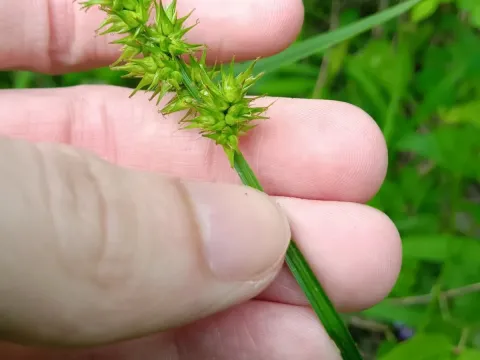
Awl-fruited sedge
Carex stipata
Awl-fruited sedge (Carex stipata) is a perennial herbaceous plant belonging to the Cyperaceae family. It is native to North America, where it thrives in moist meadows, marshes, swamps, and along the margins of various water bodies.
What the section contains
Awl-fruited sedge
Botanically, this species is a clump-forming perennial characterized by distinct triangular stems that often feature winged edges. Its leaves exhibit a vibrant green color and possess rough margins, which are a key diagnostic feature for identification among other sedge varieties.
The plant shows exceptional tolerance for saturated soils, including peat bogs, silty substrates, and clay soils with a high water table. It performs best in full sun to partial shade conditions and prefers soil pH levels ranging from neutral to slightly acidic.
Ideal climatic conditions for the development of Carex stipata include high atmospheric humidity and moderate temperatures throughout the growing season. The species is highly cold-hardy, allowing it to survive and propagate in regions with severe winter freezes.
Agricultural and ecological utilization of awl-fruited sedge includes the bioremediation of degraded aquatic ecosystems, the filtration of nutrient-rich wastewater, and erosion control along riverbanks. While not a primary forage crop, it can be integrated into managed wetlands to provide structural diversity and habitat for local wildlife.