
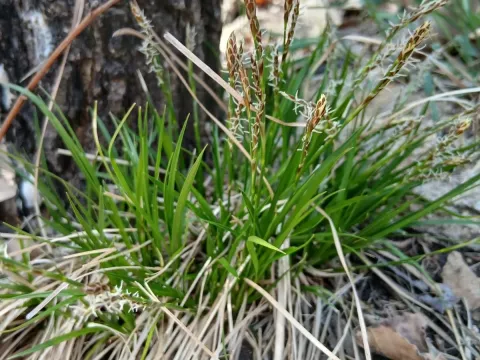
Bird's-foot sedge
Carex pediformis
Bird's-foot sedge (Carex pediformis) is a perennial herbaceous plant belonging to the Cyperaceae family. It is widely distributed across the temperate regions of Eurasia, showcasing significant environmental resilience and adaptation to diverse climatic conditions.
What the section contains
Bird's-foot sedge
Botanically, this species is characterized by its densely tufted growth habit. The narrow, linear leaves form compact clumps, making it an excellent ground cover. The specific epithet pediformis refers to the shape of its spikes, which resemble the imprint of a bird's foot.
The crop thrives in well-drained, moderately fertile soils, including sandy loams and rocky substrates. It exhibits high tolerance to cold climates and is capable of surviving harsh winters with minimal ground cover, making it a reliable species for northern agricultural zones.
Optimal growth requires exposure to sunlight, although the plant displays a degree of shade tolerance. In agricultural practice, it is often utilized for soil stabilization and erosion control on slopes where more demanding crops would fail to establish deep root systems.
Maintenance requirements are relatively low once the plant is established. It does not require frequent fertilization, as it is adapted to nutrient-poor soils in its natural habitat. Efficient water management is necessary primarily during the first growth season to ensure root development.
Carex pediformis is generally resistant to many common grass diseases. However, in conditions of poor air circulation and excessive humidity, it may be susceptible to fungal infections like rust. Maintaining proper planting density is critical for long-term health.
Pest pressure on this species is typically low. Occasional infestations of sucking insects can occur during periods of extreme drought. Early detection and localized mechanical intervention are usually sufficient to manage these minor pest populations.
Competition from aggressive weeds is the primary threat during the establishment phase. Because of its initially slow growth rate, the sedge requires a weed-free environment to develop its dense root system and dominate the plot successfully.
Waterlogging is a major risk factor that can lead to root decay. Ensuring the planting site has adequate drainage is the most effective preventative measure against root-related pathologies in this crop.
Integrated pest management strategies for this species focus on environmental manipulation rather than chemical treatment. Promoting biological diversity around the planting area helps naturally suppress potential threats without the need for synthetic pesticides.