
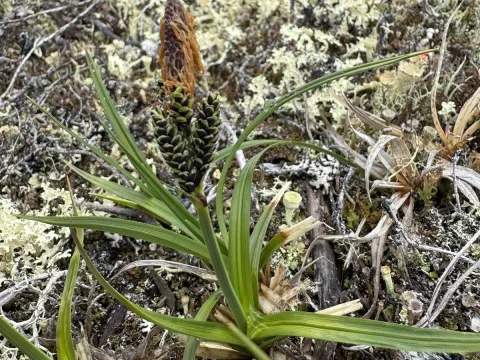
Bigelow's sedge
Carex bigelowii
Bigelow's sedge (Carex bigelowii) is a perennial herbaceous plant belonging to the Cyperaceae family. It is widely recognized for its adaptation to harsh arctic, subarctic, and alpine environments.
What the section contains
Bigelow's sedge
The plant thrives in moist to wet soil conditions and is frequently found in peatlands, heathlands, and on stony mountain slopes. It prefers acidic soil substrates that provide necessary nutrients in extreme cold.
Botanically, it is characterized by its short stature, rigid leaves, and dense, clump-forming growth habit. This structure allows it to withstand severe wind and cold temperatures common in its native range.
Climatic requirements are specific to regions with long winters and short, cool growing seasons. It requires consistent soil moisture and is highly intolerant of prolonged drought conditions.
In terms of agricultural value, Bigelow's sedge is primarily utilized as a vital forage resource for reindeer and other wild herbivores in northern latitudes, supporting local biodiversity.
The plant is susceptible to several fungal diseases, including various species of rust and smut that thrive in the cold, damp conditions of its primary habitat.
Insect pests include various larvae that graze on the leaf blades, which can cause significant damage to the plant's ability to photosynthesize during the short summer.
Habitat loss and degradation due to environmental shifts pose a threat to the density of sedge mats, impacting local ecosystems and grazing capacity.
Overgrazing by domestic or wild animals remains a primary risk factor, as it hinders the plant's ability to regenerate its dense, protective turf.
Management of these threats in natural populations relies on preserving the integrity of the soil layer and monitoring the moisture balance of the vegetation zones.