
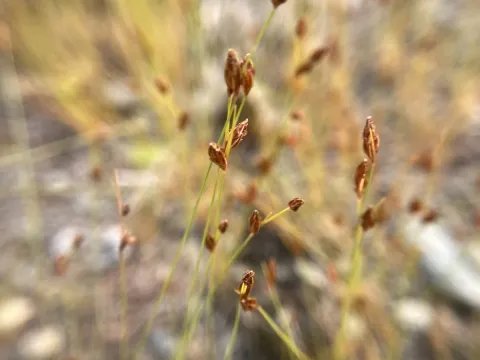
Bulbostylis capillaris
Bulbostylis capillaris
Bulbostylis capillaris is an annual sedge species belonging to the family Cyperaceae. Within an agricultural context, it is not cultivated as a crop but rather recognized as a weed that can infest various field crops and pastures.
What the section contains
Bulbostylis capillaris
The life cycle begins with seed germination during the spring months, as soon as soil temperatures reach suitable thresholds. The species is known for its ability to quickly establish itself in disturbed soil environments.
Seed production is prolific, with each individual plant capable of shedding thousands of tiny seeds. These seeds are easily dispersed by wind, water run-off, and agricultural machinery during harvest or soil tillage operations.
The plant completes its life cycle within a single growing season. By maturing rapidly, it can produce multiple cohorts of seeds if conditions remain favorable throughout the summer, creating a persistent seed bank.
Successful colonization often occurs where soil has been exposed. Proper field management is essential to prevent the accumulation of this plant’s seeds in the soil profile over successive years.
Bulbostylis capillaris thrives in well-drained, sandy, or gravelly soils. It is particularly well-adapted to acidic soil conditions where many competitive grass species might struggle, allowing it to dominate patches.
High light requirements are a defining characteristic of this sedge. It generally fails to compete in dense crop canopies, making it a problem mainly in thin stands or in the early stages of crop development.
The plant requires moderate to warm temperatures for optimal metabolic activity. It is highly sensitive to frost, which effectively ends its growth cycle at the end of the agricultural season.
Moisture availability is necessary for germination, though once established, the plant exhibits some tolerance to moisture variability. It is frequently found in seasonally dry habitats that experience transient saturation.
Low soil fertility is not a limiting factor for this species. It has evolved to survive in nutrient-poor environments, enabling it to persist where other crops might require fertilization to reach maturity.
The primary agricultural threat posed by Bulbostylis capillaris is its competition with crops for light, nutrients, and water. This competition leads to reduced vigor and lower overall yields in affected areas.
As a member of the Cyperaceae family, it can act as an alternate host for various pathogens and pests. These biological threats can migrate to neighboring crops, potentially complicating pest management strategies.
Fungal infections such as rusts and various leaf spots have been observed on this species. Monitoring for these diseases is necessary when the weed is present in large densities near susceptible crop varieties.
Mechanical control, including cultivation and hoeing, is often the most effective way to eliminate the plant before it reaches the seed-set stage. Timing is critical for preventing further contamination of the field.
Herbicide efficacy varies significantly depending on the chemical class used. Many sedges are naturally resistant to common broad-spectrum herbicides, often requiring specific, targeted treatment programs.