
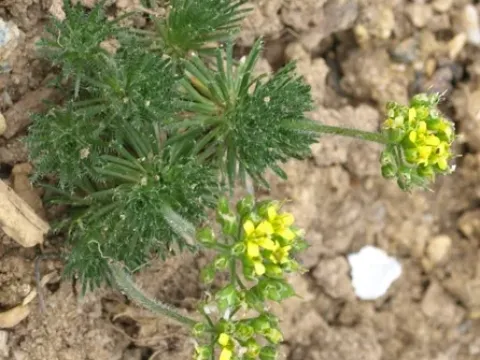
Draba compacta
Draba compacta
Draba compacta is a perennial herbaceous plant belonging to the Brassicaceae family. It is a highly specialized species that thrives in extreme high-altitude environments, exhibiting adaptations that allow it to survive in nutrient-poor, stony soils.
What the section contains
Draba compacta
The plant is anatomically characterized by a cushion-like growth habit. This morphological structure is crucial for trapping heat, protecting the plant from high-velocity winds, and minimizing water loss, which is essential in arid mountainous climates.
The natural habitat of this species is typically found in alpine and subalpine zones. It prefers rocky outcrops and scree slopes where drainage is optimal, as the root system is highly sensitive to waterlogging and soil compaction.
Regarding climatic requirements, Draba compacta is adapted to intense solar radiation and significant temperature fluctuations between day and night. It is a cold-hardy species that remains dormant during the long winter months under snow cover.
While Draba compacta is not considered an agricultural crop in the conventional sense, it is valued in botanical research and ecological restoration projects. Its ability to stabilize soil on steep mountain slopes makes it a significant organism in alpine biodiversity conservation.