
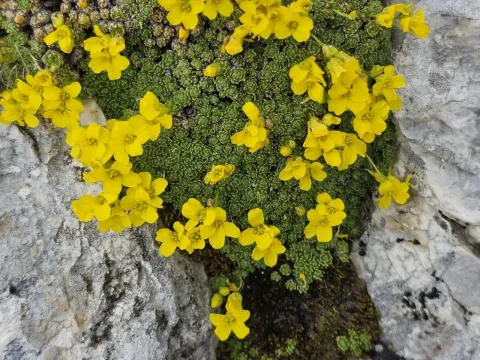
Draba bryoides
Draba bryoides
Draba bryoides is a perennial herbaceous plant belonging to the Brassicaceae family. It is a true alpine species, originating from the high-altitude mountainous regions of the Caucasus, where it thrives in rocky crevices and on stony, exposed slopes.
What the section contains
Draba bryoides
Botanically, it is recognized by its cushion-forming habit, creating dense mats that look like cushions of moss. Its small, tightly packed leaves are often densely pubescent, an evolutionary adaptation to preserve moisture and deflect intense UV rays characteristic of high elevations.
To cultivate this species, a very specific substrate is required. The soil must be exceptionally gritty and well-draining, consisting primarily of limestone chips, coarse sand, and a minimal amount of organic matter to mimic the harsh conditions of its natural environment.
The plant demands full sun exposure to maintain its characteristic compact, mounded shape. In locations with insufficient light, the cushions tend to lose their structural integrity, becoming stretched and more susceptible to environmental stress and opportunistic pathogens.
In landscaping, Draba bryoides is highly valued for its utility in rock gardens, scree beds, and stone troughs. It provides a permanent, low-maintenance aesthetic that adds a realistic alpine feel to gardens, effectively bridging the gap between decorative stone and living greenery.
The primary cultural threat to Draba bryoides is winter wetness. Persistent moisture around the root crown during dormant months is the leading cause of crown rot, which can quickly compromise the integrity of the entire cushion structure.
While relatively pest-resistant, the plant can be attacked by soil-borne larvae, such as wireworms, which can devastate the root system. Periodic checks of the soil condition and preventative measures in the surrounding area are recommended for maintaining plant vigor.
Fungal issues, particularly powdery mildew, may occur if air circulation is poor or if the foliage remains moist for extended periods. Ensuring a high-drainage environment and placing the plant in a breezy location are the best ways to mitigate these risks.
Weed competition is a constant threat to this slow-growing plant. Because it cannot compete with faster-growing vegetation, manual weeding is essential to ensure that the cushion remains undisturbed and receives adequate sunlight and nutrient flow.
To provide optimal health, growers often use a top-dressing of fine gravel or grit beneath the cushions. This simple technique acts as a barrier, keeping the foliage off the damp soil and allowing the crown to dry out rapidly after rainfall or watering.