
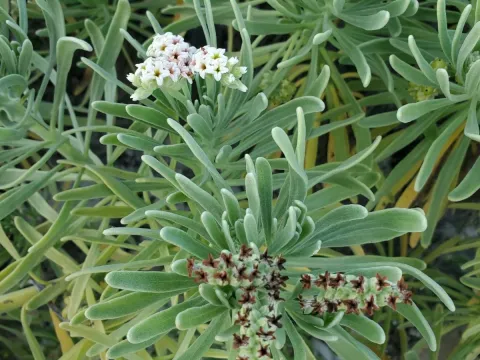
Tournefortia
Tournefortia
Tournefortia is a genus belonging to the Boraginaceae family, comprising a diverse group of plants including shrubs, vines, and small trees. Native to tropical and subtropical regions across the Americas, Africa, and Asia, these plants thrive in environments characterized by high humidity and consistent warmth.
What the section contains
 Siberian tournefortia
Tournefortia sibirica
Tournefortia acuminata
Tournefortia acuminata
Siberian tournefortia
Tournefortia sibirica
Tournefortia acuminata
Tournefortia acuminata
 Tournefortia arborescens
Tournefortia arborescens
Tournefortia arborescens
 Tournefortia bicolor
Tournefortia breviflora
Tournefortia breviflora
Tournefortia bicolor
Tournefortia bicolor
Tournefortia breviflora
Tournefortia breviflora
 Tournefortia cuspidata
Tournefortia cymosa
Tournefortia cymosa
Tournefortia foetidissima
Tournefortia foetidissima
Tournefortia cuspidata
Tournefortia cuspidata
Tournefortia cymosa
Tournefortia cymosa
Tournefortia foetidissima
Tournefortia foetidissima
 Tournefortia gnaphalodes
Tournefortia gnaphalodes
Tournefortia gnaphalodes
 Tournefortia meyeri
Tournefortia meyeri
Tournefortia meyeri
 Tournefortia paniculata
Tournefortia paniculata
Tournefortia paniculata
 Tournefortia poliochros
Tournefortia poliochros
Tournefortia poliochros
 Tournefortia sarmentosa
Tournefortia sarmentosa
Tournefortia sarmentosa
 Tournefortia scabra
Tournefortia scabra
Tournefortia scabra
Tournefortia
The climate requirements for Tournefortia are strict, as they are not frost-hardy and require temperatures that do not drop below the temperate threshold. In controlled environments, they flourish when ambient temperatures remain steady, mimicking their native tropical habitat throughout the year.
Regarding soil requirements, this culture demands a well-draining, nutrient-rich growing medium. A mixture based on peat, perlite, and organic matter is typically ideal to ensure the roots remain oxygenated while maintaining the necessary moisture for vigorous vegetative growth.
Agrotechnical management involves careful hydration. While the plants require consistent soil moisture, they are highly susceptible to root rot if left in standing water. Irrigation must be balanced with adequate drainage to promote healthy root respiration and prevent physiological stress.
In terms of хозяйственное использование (economic use), Tournefortia is primarily valued in ornamental horticulture. Its unique inflorescences and foliage texture make it a popular choice for botanical gardens and specialized greenhouse collections, often contributing to the aesthetic appeal of indoor spaces.
Common pests affecting Tournefortia include spider mites, which thrive in low-humidity environments. These arachnids colonize the undersides of leaves, causing discoloration and eventual drop if left untreated by appropriate acaricides or moisture control.
Mealybugs represent another significant threat to the culture. These pests congregate in leaf axils and along stems, feeding on plant sap and producing honeydew, which subsequently attracts secondary fungal infections like sooty mold.
Root rot, typically caused by Pythium or Phytophthora species, is the most lethal disease. It is almost exclusively the result of overwatering or soil compaction, requiring immediate repotting into fresh, sterile substrate and the removal of compromised root tissues.
Leaf spot diseases, often fungal or bacterial in origin, can occur if foliage remains wet for extended periods in environments with poor air circulation. Proper spacing between plants is essential to ensure adequate airflow and reduce the humidity levels around the foliage.
Management of these threats relies heavily on preventative cultural practices. Regular inspection, maintaining hygienic growing conditions, and ensuring that environmental stressors—such as extreme temperatures or light fluctuations—are minimized will keep Tournefortia plants healthy and robust.