
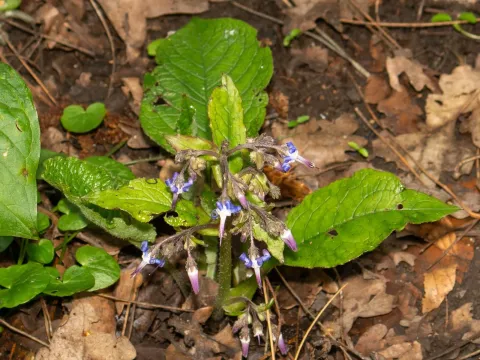
Trachystemon
Trachystemon D. Don
Trachystemon is propagated primarily through seeds or vegetatively by dividing rhizomes. Sowing seeds in open ground is best performed in late autumn or early spring, provided the seeds have undergone a stratification process to increase germination rates.
What the section contains

Trachystemon
When using vegetative propagation, segments of the rhizomes should be planted at a depth of 5–8 centimeters with a spacing of 30–40 centimeters between plants. Early spring or late summer are the most favorable times for this operation.
The crop is characterized by high growth energy; therefore, when establishing plantations, it is necessary to plan for its rapid spread across available space. Young seedlings require regular irrigation during the first year to ensure successful establishment.
A crucial factor for successful sowing is preparing a nutrient-rich, humus-heavy substrate. Seeds should be sown at a depth of no more than 1–2 centimeters, ensuring firm contact with the moist soil.
For commercial production, it is recommended to maintain a planting layout that facilitates maintenance between rows. The plant quickly forms a dense ground cover, which effectively suppresses weed growth.
Belonging to the Boraginaceae family, Trachystemon naturally favors the shaded areas of deciduous forests. In agricultural settings, it thrives best on fertile, loose, and consistently moist loamy soils.
The plant exhibits high shade tolerance, making it an excellent choice for planting in orchard understories. It does not tolerate direct, intense sunlight or prolonged drought, requiring a stable moisture regime to flourish.
While the plant does not have strict soil pH requirements, it responds best to neutral or slightly acidic substrates. Ensuring adequate drainage is essential, as waterlogging can easily lead to root rot.
In temperate climates, the plant displays significant cold hardiness and overwinters successfully without special protection. It initiates vegetation immediately after the snow melts, taking advantage of soil moisture.
For intensive biomass production, the application of organic fertilizers such as compost or manure is recommended in the spring. Mineral fertilizers should be applied with caution to avoid soil salinization.
The primary economic value of Trachystemon lies in its status as an early season honey plant, providing bees with nectar when few other plants are in bloom. Nectar productivity remains high even during cool spring weather.
The green mass of Trachystemon is edible and used as an early spring vegetable. Young leaves and shoots are rich in bioactive compounds and vitamins, which are highly valued after the winter period.
Yields of the leaf mass depend on planting density and moisture availability throughout the growing season. With proper management, several harvests of greens can be obtained during the season.
As a decorative-foliage plant, Trachystemon provides a dense ground cover that prevents soil erosion. Its biomass can also serve as an effective mulch for other garden crops.
Seed yield potential is limited by their uneven ripening; therefore, careful, selective harvesting is required to ensure high-quality propagation material.
Trachystemon is a highly resilient plant with strong natural immunity to many typical vegetable crop diseases. In dense plantings with excessive humidity, powdery mildew may occasionally occur.
The primary pests for young growth are slugs and snails, which may damage tender leaves in the spring. Barrier-based protection methods are generally sufficient to manage these populations.
Excessive soil moisture can lead to fungal infections of the root system, manifesting as root rot. Proper drainage and adequate spacing are key preventative measures against these issues.
Critical damage from insect pests is rarely observed. The crop's ability to compete with weeds reduces the need for frequent pesticide applications.
To maintain plantation health, it is important to perform sanitary cleanings by removing dead plant debris at the end of the growth cycle to prevent the accumulation of pathogens in the soil.
Young leaves are harvested in early spring when they reach marketable size while remaining tender. Leaves are typically cut using a sharp tool, leaving a portion of the petiole intact.
When harvesting seeds, it is important to account for their tendency to shatter upon full maturity. Flower heads are harvested when the majority of seeds turn dark and are then dried in shaded, well-ventilated areas.
After harvesting the greens, the plant recovers quickly due to its vigorous rhizome system. This allows for multiple harvests throughout the spring and early summer before the flowering phase.
Harvested greens lose turgor quickly, so they should be processed or sold on the day of harvest. Storage in a refrigerator under high humidity is permissible for a few days.
Rhizomes intended for propagation are excavated during the dormant phase—either in late autumn or early spring. Cleaned material should be disinfected and stored in moist sand at low temperatures.