
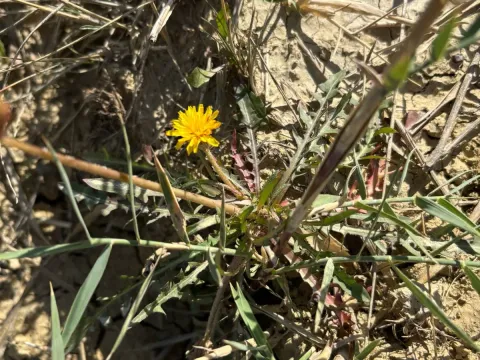
Bessarabian dandelion
Taraxacum bessarabicum
The Bessarabian dandelion (Taraxacum bessarabicum) is a perennial herbaceous plant belonging to the Asteraceae family, recognized for its specific ecological niche.
What the section contains
Bessarabian dandelion
As a notable halophyte, this species has evolved mechanisms to thrive in saline environments and alkaline soils where standard crops struggle to establish.
The plant demonstrates significant tolerance to drought conditions, supported by a deep taproot system that ensures water uptake in arid prairie or steppe landscapes.
Optimal growth requires high light intensity, as the plant is adapted to open habitats with minimal canopy cover, typical of its native range in Eastern Europe.
The soil requirements focus on moisture-retentive properties, even when salinity levels are high, as the plant utilizes salt-excretion processes to maintain cellular homeostasis.
Root rot pathogens represent the primary threat to the crop, particularly when poor drainage conditions prevail, leading to localized plant mortality.
Wireworms are the most significant insect pests, as they consume the root tissue, weakening the plant and increasing susceptibility to secondary fungal infections.
Powdery mildew may occur during periods of high humidity and poor air circulation, reducing the overall vigor and yield potential of the leafy rosettes.
Aphid infestations on the foliage can cause significant stress, resulting in stunted growth and leaf curling if left untreated during the active vegetative phase.
Integrated pest management strategies are essential to mitigate these biological risks while maintaining the ecological integrity of the cultivation area.