
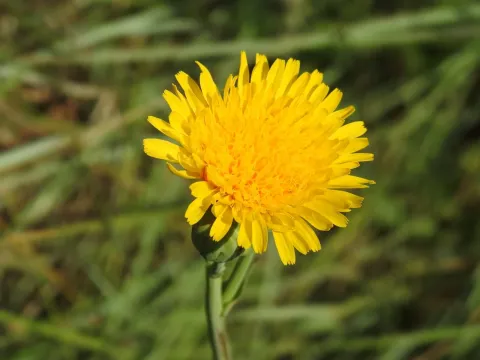
Sea sow thistle
Sonchus maritimus
Sea sow thistle (Sonchus maritimus) belongs to the Asteraceae family. It is a perennial herbaceous plant classified as a halophyte, which means it is naturally adapted to survive and thrive in soils with high salt concentrations.
What the section contains
Sea sow thistle
Its natural range encompasses coastal regions of the Mediterranean and parts of the Atlantic. It is primarily found in salt marshes and saline wetlands, environments that are typically inhospitable to standard commercial crops due to their mineral content.
Botanically, the species possesses a robust root system, often consisting of rhizomes, which aids in nutrient acquisition in harsh conditions. The leaves are typically leathery, an adaptation that reduces transpiration and helps the plant maintain water balance despite high saline stress.
The plant requires full sun exposure and is well-adapted to coastal climates with mild winters. Regarding soil requirements, it favors damp, saline environments and is capable of thriving in substrates where high electrical conductivity inhibits the growth of common agricultural crops.
Management practices for this plant involve managing saline-affected lands that are currently not productive. Unlike traditional farming, its cultivation focuses on sustainable soil use, utilizing the plant's natural ability to stabilize soil and prevent degradation in saline zones.
In terms of economic utility, sea sow thistle is primarily valued as forage for livestock capable of grazing in saline meadows. Additionally, it shows promise in land restoration projects aimed at reclaiming degraded, saline-heavy industrial or coastal sites.