
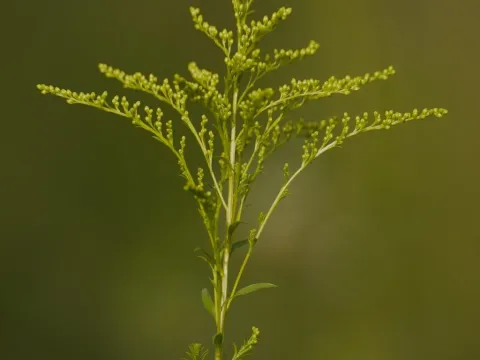
Early goldenrod
Solidago juncea
Early goldenrod (Solidago juncea) belongs to the Asteraceae family. It is a hardy herbaceous perennial that propagates naturally through seeds or vegetatively by spreading rhizomes.
What the section contains
Early goldenrod
Seeds are typically sown in late autumn to allow for natural cold stratification during winter, which significantly improves germination rates in the following spring.
For controlled cultivation, vegetative propagation by dividing established clumps in early spring or autumn is often preferred as it ensures faster establishment and genetic consistency.
Plants should be spaced approximately 30 to 50 cm apart to provide adequate airflow and minimize competition, which is crucial for maximizing nectar production and plant health.
The seeds should be sown shallowly, barely covering them with soil. Maintaining consistent moisture during the germination phase is essential until the seedlings develop a robust root system.
Early goldenrod thrives in full sun but can tolerate partial shade. It is highly adaptable to various soil types, ranging from sandy and rocky soils to rich loams, displaying excellent drought tolerance.
The plant is remarkably hardy and resilient, capable of surviving harsh winters and fluctuating moisture levels, which makes it a low-maintenance crop for various agricultural settings.
Optimal soil pH for cultivation is slightly acidic to neutral. Ensuring the soil has good drainage is vital, as persistent waterlogging can cause root crown rot and weaken the plants.
While the plant does not require heavy fertilization, an initial application of balanced fertilizer or organic compost in early spring supports vigorous growth and abundant flowering.
Effective weed management during the first year is critical. Once established, the dense root system of the goldenrod will naturally suppress most competing weeds.
The primary agricultural value of Solidago juncea is its role as a late-season honey plant, providing bees with essential late-summer forage when most other crops have finished flowering.
Beyond beekeeping, the plant is valued in the horticultural industry for its attractive bright yellow plumes, making it a popular choice for native plant gardens and landscapes.
Dried flowers of the Early goldenrod are commercially utilized in the floral industry for creating long-lasting, rustic-style dried bouquets and decorative arrangements.
In certain contexts, the plant is harvested for medicinal purposes, specifically for its mild diuretic and anti-inflammatory properties, although market demand is niche.
Commercial stands of goldenrod can be highly productive for several years, providing a consistent source of nectar without the need for annual reseeding or extensive tillage.
Powdery mildew is a common issue for goldenrod, especially in areas with high humidity or poor air circulation, which can cause white fungal growth on the leaves.
Rust diseases can occur, manifesting as orange or brown pustules on the leaf surfaces, which reduces the plant's overall aesthetic and physiological vigor.
Insects like aphids and certain leaf beetles can damage young stems and flower buds, occasionally necessitating integrated pest management strategies to protect the crop.
Preventative measures include maintaining proper plant spacing, removing infected plant debris at the end of the season, and ensuring good soil drainage to reduce humidity.
If chemical interventions are necessary, choosing systemic treatments that are safe for pollinators is essential to ensure that beekeeping activities are not adversely affected.
For decorative floral use, the harvest is performed when the flower plumes are fully open but before they begin to fade, ensuring the most vibrant color retention.
Cut stems are bunched together and hung upside down in a cool, dry, and dark location to preserve the structure and color of the flowers as they dry.
As a honey crop, no physical harvest of the plant is required; instead, the success of the yield is measured by the honey production levels within local beehives.
For any botanical or medicinal harvesting, the above-ground biomass is best collected at the start of the flowering period to capture the highest concentration of active compounds.
At the end of the growing season, after the first hard frost, the stalks should be cut back to a few inches above the ground to promote a clean and healthy regrowth in spring.