
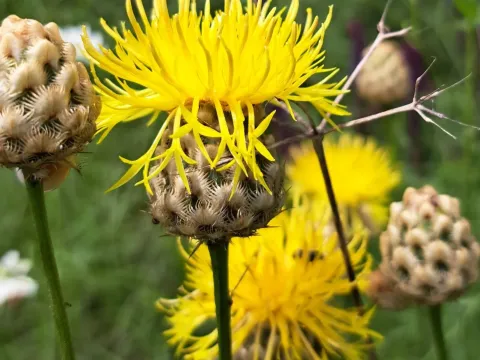
Eastern knapweed
Centaurea orientalis
Eastern knapweed (Centaurea orientalis) belongs to the Asteraceae family. This perennial herb is an emerging crop with significant potential for medicinal use and as a high-quality honey plant in agricultural systems.
What the section contains
Eastern knapweed
The plant originates from the steppe and forest-steppe regions, making it highly adaptable to continental climates. It is characterized by excellent winter hardiness and the ability to withstand summer droughts without losing productivity.
Botanically, it features a deep taproot system, which is crucial for nutrient uptake in diverse soil types. The plants reach heights of 100-120 cm and produce distinctive pinnate leaves that form a robust basal rosette during the initial growth stages.
Eastern knapweed prefers well-drained, fertile soil. While it is not overly demanding of soil chemistry, it does not tolerate waterlogging, which can cause crown rot during the winter dormancy period. Providing proper field drainage is essential.
Effective agronomy for this crop includes careful site selection to avoid fields infested with deep-rooted perennial weeds, as the plant establishes itself slowly during its first year of growth.
Sowing should take place in early spring once soil temperatures reach at least 8-10 degrees Celsius, or late in the autumn for winter stratification. Autumn planting is often preferred for more uniform seedling emergence.
Seeds should be planted at a depth of 1-2 cm. For large-scale production, row spacing of 45-60 cm is recommended to facilitate mechanical weeding and ensure the plants receive adequate space for development.
The seeding rate typically ranges from 4 to 6 kilograms per hectare, depending on seed quality. Rolling the soil after sowing helps ensure proper seed-to-soil contact, which is vital for germination in drier conditions.
Since the plant spends its first year forming a rosette, weeding is the most labor-intensive part of the management process. Ensuring the field is free of invasive weed species during this phase is critical for successful long-term establishment.
Utilizing high-quality, cleaned seeds is an important investment for producers, as it reduces the risk of contaminating the crop and simplifies the post-harvest processing of the medicinal raw materials.
The primary agricultural objective for Eastern knapweed is the production of medicinal biomass, which is harvested during the peak flowering stage. This phase typically occurs from mid-June to late July.
Harvesting is performed by mowing the plant at a height of 10-15 cm from the ground. Mechanical harvesting equipment is highly efficient for this crop, allowing for rapid collection before the plant loses its essential oils.
Post-harvest handling requires quick drying. The biomass should be spread thinly in well-ventilated sheds, away from direct sunlight, or dried in specialized ovens set to 40-50 degrees Celsius to preserve volatile compounds.
Proper drying is essential for maintaining product quality, as moisture trapped during storage can quickly lead to mold development, which would render the entire batch unsuitable for medical or commercial use.
Once dried, the raw material is processed to remove coarse stems and debris, then packed in moisture-resistant materials for storage in cool, dry conditions until it is ready for market.
Eastern knapweed is generally resilient, but high humidity levels can invite fungal diseases like powdery mildew. Maintaining adequate spacing between rows helps improve airflow and reduces the risk of fungal outbreaks.
Insects such as aphids and weevils may target the flower heads and young foliage. Integrated Pest Management (IPM) practices, including regular monitoring and the use of soft chemical or biological controls, are effective.
Cutworms can cause damage by feeding on young leaves, necessitating vigilance during the early stages of plant growth. Field scouting is the best way to determine if a pest population requires an intervention.
Weed management remains the most significant challenge in the first two years of the crop's lifecycle. Mechanical cultivation is preferred over herbicides to ensure the purity of the medicinal product.
- Mechanical weed control.
- Soil moisture management.
- Preventive inspection for fungi.