
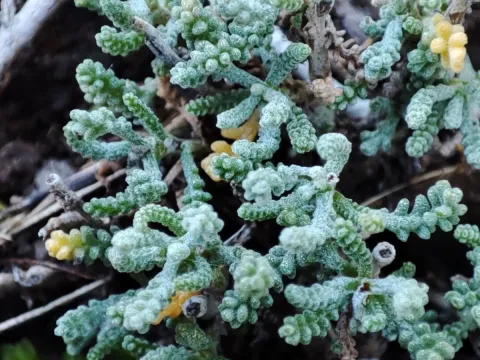
Majorcan Santolina
Santolina magonica
Sowing of Majorcan Santolina (Santolina magonica) seeds is typically carried out in late winter or early spring in a greenhouse or controlled environment.
What the section contains
Majorcan Santolina
Transplanting seedlings to open ground should occur only after the risk of frost has passed to ensure the establishment of the root system.
The seeds require a well-draining, sandy substrate to germinate effectively, usually taking a few weeks to sprout under warm conditions.
Vegetative propagation via cuttings taken in late spring is a common commercial practice to ensure high uniformity of the crop.
When sowing, avoid deep covering of the seeds; a light dusting of soil is sufficient to allow light to penetrate for germination.
Belonging to the Asteraceae family, the Majorcan Santolina is a classic Mediterranean subshrub that demands full sun exposure to maintain its vigor.
The crop thrives in poor, rocky, or sandy soils and is highly susceptible to root diseases if planted in heavy or waterlogged clay-based substrates.
Adequate air circulation is a mandatory requirement to prevent humidity-related issues, which are the main cause of plant failure in non-native climates.
Once established, the plant is remarkably drought-tolerant, making it an excellent candidate for water-wise landscapes and rock gardens.
Soil pH should remain near neutral or slightly alkaline, as acidic conditions can negatively impact the plant's overall health and growth rate.
Root rot caused by Phytophthora or similar fungi is the most significant threat to this species, usually triggered by excessive irrigation or poor drainage.
Aphids and spider mites are common pests that may infest the dense foliage, especially during hot and dry summer months if the plant is stressed.
Preventative measures include avoiding overhead watering and ensuring that the foliage stays dry to minimize the risk of fungal leaf spots.
Monitoring the plants regularly allows for early detection of pest activity, enabling the use of organic soaps or neem oil for control.
- Maintain spacing between plants for ventilation.
- Avoid over-fertilization, which encourages weak growth.
- Prune dead or diseased branches immediately to prevent spread.
The harvest of Majorcan Santolina is focused on its aromatic foliage and flowers, which are rich in essential oils used in various industries.
The ideal harvesting window is at the onset of flowering, as the chemical concentration of volatile compounds is at its annual peak.
Harvested material should be dried in a dark, airy location to preserve the characteristic silvery-grey color and the distinct herbal aroma.
Beyond its use as an aromatic crop, the plant is pruned annually to maintain its compact, rounded shape, which is essential for ornamental use.
Properly cured and stored, the dried product remains shelf-stable for long periods, serving as a source of high-quality botanical extract.