
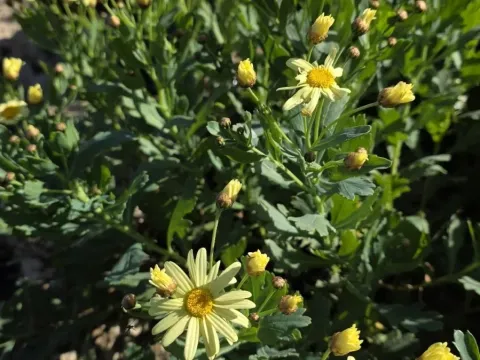
Marguerite Daisy
Argyranthemum Webb ex Schultz Bip.
Argyranthemum is typically propagated via seeds or stem cuttings. Seed sowing is performed in late winter to early spring under controlled indoor conditions to ensure uniform germination.
What the section contains


Marguerite Daisy
The seeding medium should be light, well-draining, and rich in nutrients. Seeds require warmth and consistent surface moisture during the initial development stage to ensure high seedling vigor.
Cuttings are preferred for maintaining the specific characteristics of ornamental cultivars. Cuttings should be harvested from healthy, non-flowering shoots and placed in a damp rooting medium.
Young plants need to be hardened off before being transplanted outside. This transition period allows the flora to acclimatize to environmental fluctuations and UV exposure.
Spacing requirements vary depending on the variety, but generally, 30 to 50 cm between plants is sufficient. Adequate spacing ensures airflow and reduces the risk of fungal diseases.
The genus Argyranthemum belongs to the Asteraceae family and is native to the Canary Islands. It is valued for its continuous flowering and is commonly grown as a seasonal annual in cooler climates.
This crop demands a sunny location with full light exposure to maximize flower production. In shaded conditions, the plant tends to become leggy, losing its compact shape and floral density.
Soil requirements include well-drained, fertile, and slightly acidic or neutral substrates. Waterlogged conditions must be avoided as they lead to root decay and overall plant stress.
Argyranthemum thrives in temperate environments with consistent moisture. It does not tolerate extreme heat combined with high humidity, nor does it survive heavy frost during the winter months.
Regular maintenance involves light pruning of spent blossoms to encourage secondary blooming cycles. Supplemental fertilization with balanced phosphorus and potassium fertilizers promotes healthy growth and vibrant petal color.
Common pests affecting Argyranthemum include aphids, spider mites, and whiteflies. These insects pose a threat by colonizing the tender foliage and sucking vital sap from the vascular system.
Fungal issues such as powdery mildew and gray mold frequently occur when humidity is high and ventilation is poor. These conditions are conducive to rapid pathogen proliferation on leaves and buds.
Cultural control, such as removing debris and ensuring adequate spacing, is the first line of defense against disease. Preventing foliage wetness during irrigation is also crucial for overall plant health.
Systemic insecticides should be applied upon the first sighting of infestation. It is essential to treat both the upper and lower surfaces of the leaves to ensure full coverage and efficacy.
Monitoring for signs of root rot is vital in containers, where soil saturation is more likely. If soil remains soggy for extended periods, amending the substrate or adjusting irrigation frequency is necessary.