
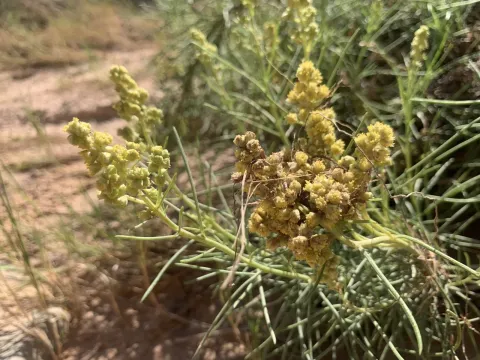
Oxytenia
Oxytenia
Oxytenia is a monotypic genus of plants belonging to the Asteraceae family. It is a perennial shrub that has evolved to thrive in extreme arid conditions, showing remarkable resilience to drought, high temperatures, and saline soil conditions.
What the section contains
Oxytenia
The natural habitat of this plant includes the desert and semi-desert regions of the Southwestern United States and Northern Mexico. It is typically found in alluvial plains and river basins where its deep taproot system can access moisture stored in deep underground strata.
Botanically, Oxytenia presents as a dense, woody shrub with grey-green stems and small, narrow leaves, a morphological adaptation to minimize water loss through transpiration. The plant grows to approximately 1–1.5 meters in height and produces typical composite flower heads.
Agronomic management of Oxytenia remains in the experimental stages, as it is not a widely cultivated crop. Successful cultivation requires full sun exposure and well-drained, sandy or rocky soils, as poor drainage and waterlogging significantly increase the risk of root pathogens.
The primary agricultural and industrial interest in Oxytenia stems from its potential as an alternative source of natural rubber and resins. Given the accelerating climate crisis, it is viewed as a candidate for developing sustainable crops on marginal land unsuitable for traditional field agriculture.