
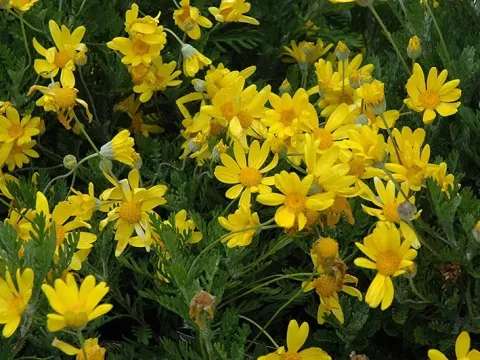
Euryops
Euryops (Cass.) Cass.
Euryops is a genus of evergreen shrubs belonging to the Asteraceae family. Native to the arid regions of Southern Africa, these plants are highly valued for their bright yellow, daisy-like flowers and fine, ferny foliage which creates a striking visual contrast.
What the section contains


Euryops
Botanically, these plants are well-adapted to high irradiance and low rainfall. They feature a woody stem base that supports dense clusters of branches, making them an excellent choice for xeriscaping or container gardening in temperate climates where they must be moved indoors during frost.
Regarding soil requirements, Euryops demands excellent drainage. The ideal substrate should be sandy or loamy, providing sufficient aeration to prevent root hypoxia. Soil pH should ideally be neutral or slightly acidic for optimal nutrient uptake.
Environmental conditions are critical for Euryops. These plants require full sun exposure to flourish and maintain their compact growth habit. Reduced sunlight often leads to leggy branches and decreased flower production, which diminishes the ornamental value of the culture.
Cultural practices involve minimal but consistent maintenance. Regular pruning is necessary to maintain the shrub's shape and encourage a flush of new growth. Fertilization should be limited to the early growing season to avoid stimulating excessive soft tissue that attracts pests.
The primary pests affecting Euryops are spider mites, especially in indoor settings where humidity levels are low. These pests can cause significant discoloration and leaf drop if not managed promptly with targeted acaricides.
Mealybugs are another common threat, often found clustering in the leaf axils of the shrub. Using horticultural oils or systemic insecticides can help manage these pests effectively while preserving the plant's delicate foliage.
Fungal diseases like powdery mildew are frequently linked to poor environmental control. High humidity combined with stagnant air creates perfect conditions for fungal spores to colonize the foliage, requiring systemic fungicides for effective control.
Root rot is the most dangerous condition for Euryops, almost exclusively caused by overwatering or poor drainage. The loss of root function usually results in rapid yellowing of the foliage, and if caught early, it requires immediate repotting into well-draining material.
Integrated Pest Management (IPM) practices, including proper plant spacing and consistent monitoring, are essential for healthy Euryops cultivation. Maintaining high hygiene standards by removing dead leaves and debris prevents potential disease outbreaks.