
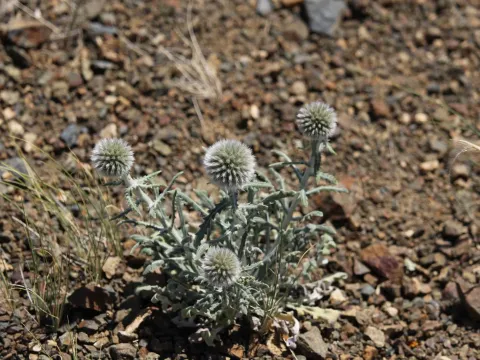
Small globethistle
Echinops humilis
Sowing of Small globethistle seeds is primarily carried out in the spring, once the soil has warmed up to 10-12 degrees Celsius, or as a late autumn sowing.
What the section contains
Small globethistle
To ensure uniform germination, seeds require a period of stratification at a temperature of about 5 degrees for several weeks, which increases field emergence.
The sowing depth in light soils is 2-3 centimeters, whereas for heavier clay soils, it is recommended to reduce the depth to 1-1.5 centimeters.
Row spacing in commercial production should be 45-60 centimeters to provide each plant with the necessary space for optimal development during the vegetation period.
After sowing, the field must be rolled to ensure firm contact between the seeds and moist soil, avoiding air pockets in the seedbed.
Small globethistle is a perennial herbaceous plant belonging to the Asteraceae family, characterized by high drought resistance and low requirements for soil fertility.
The crop prefers well-lit areas, as shade causes excessive stem elongation and significantly reduces the productivity of the flowering process.
The plant thrives in sandy loam and loamy soils with a neutral pH, while being extremely sensitive to waterlogging and high groundwater levels.
In its natural habitat, the plant is found in steppe and forest-steppe zones, having adapted to significant temperature fluctuations between day and night.
It survives well in temperate climates due to its powerful root system, which reaches deep into the soil to provide the plant with moisture during dry spells.
The primary economic value of the Small globethistle lies in its status as a valuable melliferous plant, capable of producing nectar even during dry seasons.
Honey productivity of the crop can reach 300-500 kilograms of honey per hectare under proper agricultural practices and favorable weather conditions.
Flowering begins in the second half of summer and lasts for about a month, providing bees with a stable source of forage when other plants have ceased blooming.
Seed productivity is also an important metric, allowing for the expansion of the cultivation area through self-produced quality seed material.
Beyond its nectar-producing qualities, the plant contains bioactive compounds, specifically the alkaloid echinopsine, making it a potential source for the pharmaceutical industry.
The main threat to globethistle crops is posed by fungal diseases that develop under conditions of high air humidity and waterlogged soil.
The most common pathogen is powdery mildew, which covers leaves in a white coating and inhibits the normal photosynthetic process of the plant.
Pests such as leaf-eating insects and aphids pose the greatest danger, as they can attack young sprouts and significantly slow down vegetative growth.
The root system is susceptible to rot in waterlogged conditions, requiring strict control over field drainage and the selection of appropriately contoured terrain.
- Timely removal of weeds during the early growth stage.
- Adherence to crop rotation to prevent the accumulation of soil-borne pathogens.
- Preventative fungicide treatments upon the first signs of disease.
The harvesting of seeds is carried out during the period of full maturity, when the seed heads turn a grey or brownish color and become brittle.
It is essential to harvest in dry weather, as high seed moisture complicates cleaning and leads to a rapid loss of viability during storage.
Mechanized harvesting requires setting the combine drum to low speed to minimize mechanical damage to the seed material.
After threshing, the seeds must be dried in well-ventilated areas or specialized dryers at temperatures not exceeding 35 degrees Celsius.
Cleaning seeds from debris is performed using winnowing or calibration machinery, after which the material is packaged for further distribution.