
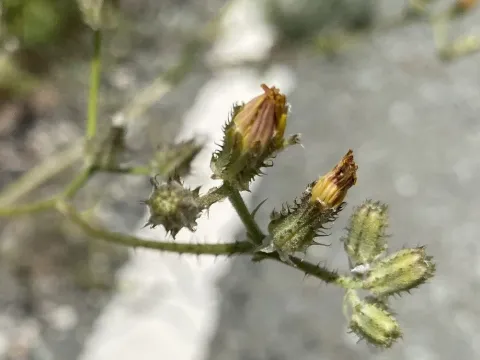
Rough hawksbeard
Crepis aspera
Rough hawksbeard (Crepis aspera) is an annual plant belonging to the Asteraceae family. While it is not a primary cultivated crop, it is a significant botanical subject often encountered in agricultural landscapes and disturbed environments across the Mediterranean region and parts of Asia.
What the section contains
Rough hawksbeard
The plant thrives in open, sunny habitats and is remarkably well-adapted to arid conditions. Its ecological success is largely attributed to its drought tolerance, which allows it to persist in areas where water availability is frequently limited during the growing season.
Soil requirements for Crepis aspera are relatively flexible. It is most commonly found on well-drained, sandy, or gravelly soils. It displays a degree of tolerance to saline conditions, allowing it to colonize edges of fields and roadsides where other vegetation might struggle.
Botanically, the plant is distinguished by its rough, hirsute texture, which covers the stems and leaves. This tactile feature, which gives the plant its name, serves as a defense mechanism against herbivores and helps minimize transpiration in dry climates.
Growth morphology involves a branched stem and yellow flower heads that mature into seeds equipped with pappi, facilitating wind dispersal over significant distances. This reproductive strategy ensures the rapid colonization of adjacent agricultural lands.
Various insects, such as aphid species and lepidopteran larvae, serve as natural limiting factors for Crepis aspera. By feeding on the sap or floral tissues, these pests can effectively reduce the plant's overall seed production capacity during the season.
Fungal pathogens such as powdery mildew can affect the plant during humid periods. The mycelial growth on leaf surfaces inhibits photosynthesis, causing localized necrosis and stunting the growth of the affected parts of the plant.
Rust fungi are another potential threat, characterized by the development of pustules on the stem or foliage. These pathogens disrupt the plant's vascular system, leading to a general decline in health and competitive vigor.
In agricultural settings, the presence of these threats does not necessarily eradicate the plant, but it does influence its population dynamics. Effective weed management in fields typically involves an integrated approach combining mechanical weeding and chemical treatments.
The resilience of Crepis aspera to environmental stressors makes it a persistent challenge for farmers. Therefore, timely detection and aggressive control measures during the early growth stages are essential to prevent it from establishing a dominant presence in crop fields.