
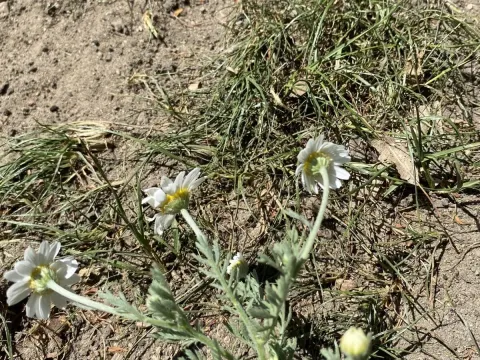
Ruthenian chamomile
Anthemis ruthenica
Ruthenian chamomile (Anthemis ruthenica) is a member of the Asteraceae family. In agricultural settings, it is primarily recognized as a persistent weed that can significantly interfere with crop productivity.
What the section contains
Ruthenian chamomile
The plant originates from the steppe and forest-steppe regions of Europe and Western Asia. It thrives in open habitats, demonstrating a high preference for dry, sunny locations and well-drained, sandy soils.
Botanically, it is characterized by a branched stem and finely divided, feathery foliage. These adaptations allow the plant to conserve moisture while maximizing photosynthetic capacity under high solar radiation.
Regarding climate, Anthemis ruthenica is highly adaptable to drought conditions. It can complete its life cycle in areas where other plants might struggle due to limited rainfall and high temperatures.
Its demand for soil nutrients is relatively modest compared to commercial crops, which allows it to outcompete standard cultivars in nutrient-poor or degraded soils, further complicating field management strategies.
The main risk posed by Ruthenian chamomile is its role as a prolific competitor for water and sunlight. Its ability to produce vast quantities of wind-dispersed seeds makes it a difficult species to eradicate once established.
The plant can act as an alternative host for various agricultural pests, including aphids and specific beetles. This creates a bridge for insect populations to migrate into primary crops, increasing the pressure of infestation.
Disease management involves monitoring for fungal pathogens that may find a habitat on the weed foliage. Control measures are most effective when implemented early, targeting the plant before it reaches the flowering stage.
Integrated weed management (IWM) techniques are recommended, including mechanical tillage and the use of competitive cover crops. These methods help suppress the growth of the weed before it can reach maturity.
Chemical control via selective herbicides is a common practice in large-scale farming. However, timing is critical, as later-stage plants develop high tolerance to standard herbicide applications used in grain production.