
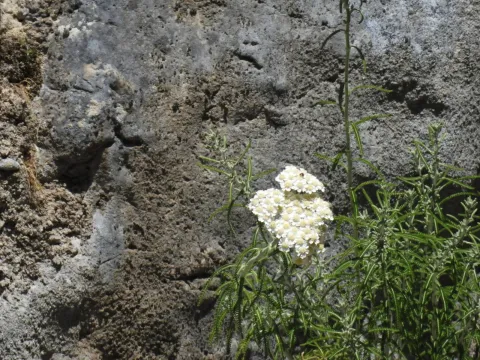
Cretan yarrow
Achillea cretica
Sowing Cretan yarrow in temperate climates is recommended in spring, once the soil has warmed to 10-12 degrees Celsius. Seeds have high germination rates, but they benefit from cold stratification to ensure uniform emergence in field conditions.
What the section contains
Cretan yarrow
When using the seedling method, sowing is carried out in March within greenhouse substrates. Transplanting the prepared plants to the open field is performed in late May, once the risk of late frosts has passed.
The optimal sowing pattern involves row spacing of 45-60 centimeters to ensure adequate air circulation. Plants are spaced 25-30 centimeters apart within the rows.
The crop propagates successfully not only by seed but also vegetatively through division of the root clump in early autumn or spring. This allows for faster establishment of dense stands on production plots.
For late-autumn sowing, seeds are planted in late October, allowing for natural soil stratification. This method facilitates earlier and hardier seedling emergence as spring arrives.
Cretan yarrow belongs to the Asteraceae family and is a typical xerophyte adapted to Mediterranean climate conditions. The plant prefers sunny locations with light, well-drained soils.
The crop is extremely sensitive to waterlogging in the root zone. In heavy clay soils, drainage systems or raised beds are required to prevent plant death due to damp-off or root rot.
Optimal pH levels for successful cultivation range from 6.0 to 7.5. The plant efficiently extracts nutrients from poor soils, making it highly undemanding regarding supplemental fertilization.
During the growing season, the plant handles prolonged droughts excellently thanks to its deep, well-developed root system. However, for maximum green biomass production, moderate irrigation during the budding phase is recommended.
High resistance to ultraviolet radiation and wind stress makes this species suitable for open slopes and erosion-prone areas, contributing significantly to soil stabilization.
The yield of Cretan yarrow raw material depends on planting density and the intensity of solar exposure. With proper agronomy, a consistent yield of the plant's aerial parts can be achieved per hectare.
The main commercial value lies in the inflorescences and leaves, which are rich in essential oils and bioactive compounds. Harvesting is conducted during mass flowering to achieve the peak concentration of beneficial components.
After cutting, the plant is capable of rapid regrowth, allowing for a secondary harvest at the end of the season under favorable conditions. This perennial crop maintains profitability on the same field for up to five years.
For processing, the raw material undergoes gentle drying in shaded, well-ventilated facilities at temperatures not exceeding 40 degrees Celsius. This preserves the plant's natural color and chemical composition.
Production efficiency is enhanced by utilizing specialized harvesters for essential oil herbs, which minimize losses of flower heads during the cutting process.
The crop possesses high natural resistance to diseases due to the presence of specific terpenoids in its tissue. However, water management failures can lead to outbreaks of fungal infections.
Powdery mildew and root rot are the most common issues, typically triggered by excessive humidity and poor soil aeration. Prevention relies on selecting proper planting sites and maintaining strict crop rotation.
Pests such as aphids and mirid bugs are occasionally observed on yarrow plantings. These insects feed on the cell sap of young leaves, reducing the plant's aesthetic value and overall yield.
In organic farming, pest control involves biopesticides based on plant extracts and the use of beneficial insects (entomophages). The use of synthetic pesticides is restricted due to the medicinal use of the raw material.
Systematic weeding between rows is a critical protective measure, as weeds can create a favorable environment for pest reproduction and pathogen development.
Harvesting begins when the inflorescences are in full bloom but have not yet started to produce seeds. At this stage, the content of active substances in the plant reaches its maximum level.
Cutting tools must be sharp and sanitized to avoid mechanical damage to the plant. The harvest cut should be made 10-15 centimeters above the ground, leaving the lower leaves for regeneration.
The cut mass is immediately sent for primary processing or drying. Exposure to direct sunlight after cutting leads to rapid evaporation of essential oils and loss of quality.
In large-scale operations, mechanized harvesting is practiced, followed by finishing the raw material in specialized drying complexes. Quality is monitored based on moisture content, which must be kept below 12 percent.
Finished dry raw material is stored in airtight containers in dry, cool rooms. This protects the product from light and moisture, ensuring a long shelf life.