
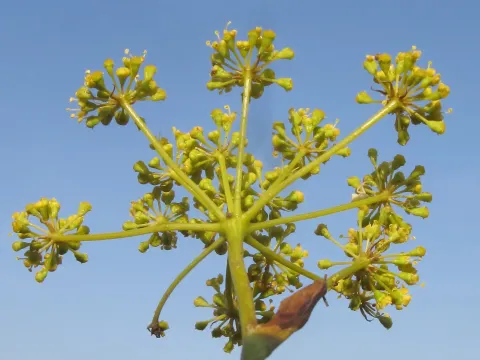
Peucedanum tauricum
Peucedanum tauricum
Peucedanum tauricum is typically sown in late autumn or early spring, requiring a period of cold stratification to ensure uniform seed germination.
What the section contains
Peucedanum tauricum
The seeds should be sown at a shallow depth of approximately 1 to 2 centimeters in well-prepared, friable soil to facilitate successful seedling emergence.
Spacing between rows should be maintained at 45–60 centimeters, allowing sufficient space for plant development and preventing excessive competition for nutrients.
In large-scale agricultural production, precise seed drills are recommended to ensure optimal plant density per square meter and efficient field maintenance.
Adequate soil moisture must be maintained during the initial weeks after sowing, especially in spring, to support the delicate root development of the young plants.
As a member of the Apiaceae family, Peucedanum tauricum thrives in sunny, open locations where it can receive maximum exposure to natural light.
The plant is highly adaptable to well-drained sandy or loamy soils, showing remarkable tolerance to drought once established in the field.
It performs best in soils with a neutral or slightly alkaline pH and requires excellent drainage, as it is susceptible to root rot in waterlogged conditions.
This crop is generally hardy and can withstand fluctuations in temperature, making it suitable for cultivation in varied climatic conditions within its range.
Agricultural management should prioritize minimizing water retention in the soil and providing proper air circulation to encourage healthy plant growth.
Fungal diseases, including powdery mildew, represent a significant challenge for this crop, especially in environments with high humidity and poor ventilation.
Root rot caused by excessive soil moisture remains a primary threat to the longevity and productivity of the crop throughout its growing season.
Insect pests, such as aphids, frequently infest the flowering stems, which can lead to reduced seed quality and weakened plant structural integrity.
Larvae of various Umbelliferae-specializing flies may damage the root neck or stems, necessitating early intervention to prevent widespread infestation.
Integrated pest management strategies, including crop rotation and the removal of infected plant debris, are essential for maintaining a healthy and productive crop.
The aerial parts of Peucedanum tauricum are ideally harvested during the full bloom stage, as this is when the concentration of beneficial compounds is highest.
Roots should be harvested at the end of the growth cycle in autumn or very early in the spring, before the plant begins its active vegetative growth phase.
Post-harvest processing involves drying the plant material in well-ventilated, shaded areas to preserve its chemical profile and prevent quality loss.
Seed collection requires careful timing as the seeds on individual umbels may mature unevenly, increasing the risk of loss if not monitored correctly.
The final yield must be thoroughly cleaned and stored under controlled environmental conditions to ensure longevity and suitability for commercial use.